Blog · Pruning calendar
Opening up a tree all at once here scorches its bark
A tree’s crown is also its sunshade. When it’s opened up all at once, the sun reaches bark that hasn’t been exposed in thirty years, and here that isn’t a metaphor.
 By Sergio Domínguez8 min read
The request almost always comes the same way: “this tree has got too big, take it down by half.” And it sounds reasonable, because it seems you’re taking a weight off the tree.
It’s the pruning that ruins more trees on this coast than any other. Not because of the cut itself, but because of what the cut leaves exposed.
The crown is also the tree’s sunshade
This is what hardly anyone has in mind. A mature tree has spent decades building its crown, and that crown doesn’t only shade the garden: it shades its own wood.
The trunk and main branches of a big tree have gone thirty or forty years without direct sun. Their bark has formed to live in the shade: it’s thinner than it would be out in the open, and it has nothing to protect it from sunburn.
The same tree, one prune too many
The crown doesn’t only shade the garden. It shades its own trunk and its own branches, which have gone decades without direct sun and aren’t ready for it.
Take off half the crown at once, and that wood is left exposed. And here, July sun on bark that has never seen it isn’t a nuisance: it’s a burn, and it shows within a few weeks.
The tree responds by filling up with water shoots. Thin, upright, poorly attached shoots that come out in a hurry to cover it. It isn’t recovering: it’s covering a wound.
When half the crown is opened up at once, that wood goes from permanent shade to full sun in a single morning. And here that isn’t a nuisance: it’s a real burn, the kind that cracks the bark and leaves it peeling off in plates within a few months.
This is where this climate changes the rules. Somewhere with real winters, an opened-up crown leaves the wood exposed to weak sun, and only for part of the year. Here it leaves it exposed to five months of almost vertical sun, and the south- and west-facing sides of those branches are the ones that pay.
And then come the water shoots
The other consequence is the one you see first, and it’s usually read the wrong way round. Within a few months the tree fills up with thin, upright shoots packed close together, especially around the big cuts. These are water shoots.
A lot of people take them as a good sign: “look how strongly it’s come back.” That’s not what it is. It’s an emergency response to make leaf again as fast as possible, because the tree has lost the surface it fed itself with and shaded itself with.
And they have a built-in flaw: they don’t grow from a structural union like a normal branch, but from surface tissue. They grow fast, get long and are poorly attached. A few years on you have a tree with twenty badly anchored upright branches right where there used to be one well-set branch, and that really does end up as a safety problem. How to spot it is covered in the signs that a tree is dangerous.
They also force you to come back. A tree that’s been cut down in size has to be gone over every few years because the water shoots take off, so today’s cheap prune turns into a recurring one.
So how much can you take off?
Less than people think, and the practical rule isn’t a percentage but a question: will any wood end up in the sun that wasn’t before?
If the answer is yes, the work has to be spread over several visits, seasons apart, so the bark can adapt gradually and the tree has time to grow back leaf between one and the next. It’s slower and it turns out better.
And there’s an alternative that’s almost never offered and that solves half the cases: thinning instead of cutting down. Removing whole branches from where they join (the dead ones, the crossing ones, the ones growing inwards) lets light and air through, reduces the weight and the wind resistance, and doesn’t change the silhouette or expose the wood. The tree goes on shading itself.
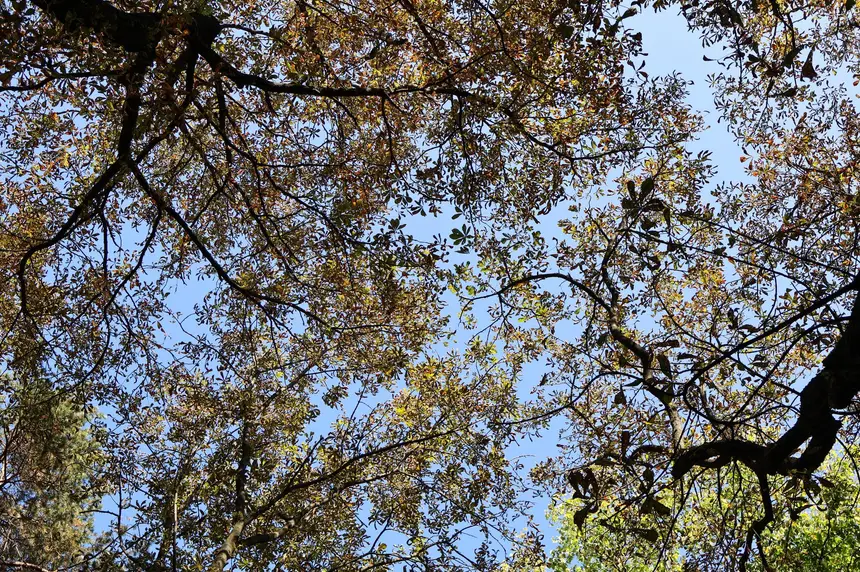
This is what a crown that lets light and air through looks like: you can make out the branch structure, you see sky through the gaps, and the tree still has the silhouette it had. That’s what thinning is after, and it looks nothing like taking a tree down by half.
When it’s done, while we’re at it
A hard prune is planned in autumn and carried out in winter, which is when the tree is most at rest and when any wood left exposed has months of gentle sun ahead of it to toughen up before June.
Doing it in spring or early summer is the worst possible combination: the crown is opened up just before the months of strong sun. What’s due in each month is in the Costa del Sol pruning calendar. And what’s best left alone right now is in what not to prune in autumn.
This happens more in communities than in private gardens, and for a specific reason: the trees in the urbanisations of the sixties and seventies were planted too close to the buildings, so every few years someone asks for them to be cut down in size. The way out isn’t to cut them back again; we explain it in garden maintenance for communities.
If it’s already been done to your tree
That’s the most likely case, because there are a great many cut-back trees on this coast. The first reaction is usually to cut all the water shoots off at the base, and it’s the wrong one: removing them all at once repeats the problem. You leave the wood without leaves and without shade again, and the tree responds by putting out more.
What works is the opposite, and it takes time. The best-placed water shoots, with the best angle, are kept; the ones getting in each other’s way are removed; and over several years they’re gradually selected until a few thicken up and become real branches. The tree ends up with a crown again, even if it isn’t the one it had.
And meanwhile, the bark that was exposed is grateful for any shade. If there’s a way of giving it some afternoon shade in the first few summers (another plant, an awning, whatever it takes), it shows.
In short
Before taking a tree down by half, it’s worth knowing that its own crown is what protects its wood, and that here the sun doesn’t forgive bark that isn’t used to it.
You almost always get what you’re after (less shade, less bulk, less risk in the wind) by thinning rather than cutting down. And when a lot really does have to come off, it’s spread over several winters.