Blog · Pruning calendar
When to prune oleander, and how to rejuvenate one that’s grown huge
Here oleander never stops growing and ends up as a wall that’s bare at the bottom with the flowers on top. When it’s pruned, how to renew it without going a year without a hedge, and why its cuttings aren’t burnt.
 By Sergio Domínguez7 min read
Oleander is probably the most planted shrub on this coast: in the central reservation of the motorway, on the embankments and as a screen in almost every urbanisation. It stands up to sun, drought and salt, and flowers from May into the autumn without asking for anything. That’s why nobody prunes it, and that’s why, over the years, it ends up as a wall of bare sticks with the flowers on top.
The question that comes in at this time of year is when to prune it. The short answer is at the end of winter. The long one explains why, and what to do with one that has already got out of hand.
The short answer: at the end of winter
Oleander flowers at the tips of the year’s shoots. Whatever you cut in late winter, before it gets going, shoots again in spring and flowers that same summer. That’s why it takes hard pruning without losing the season: the February cut doesn’t take its flowers away, it moves them.
In autumn, only the minimum. Here it’s still in flower in October, and a hard prune now gains you nothing: you take off the last flowers and you’ll have to go over it in spring anyway. What you can do is tidy it up: the dead flower clusters, broken branches and whatever is in the way. What you can and can’t touch at this time of year is in what not to prune in autumn.
Why it gets so big here
Where it freezes, winter stops it in its tracks every year. Not here: it grows from spring to autumn without a break, and every year adds more on top. Since the flowers come at the tips, the leaves and flowers climb with them, and the lower part is left in the shade, loses its leaves and turns to bare stick.
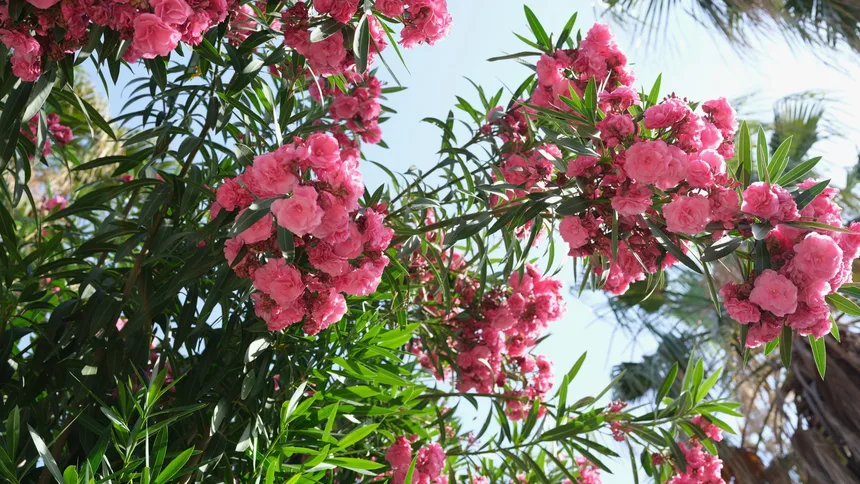
An oleander seen from below: each cluster comes at the tip of a long shoot. If nobody prunes it, that tip climbs a little every year, and the flowers climb with it.
The result is what you see in so many urbanisations: thick trunks bare up to head height, a mass of leaves on top, and the flowers where whoever planted it can no longer see them. And as a screen it fails exactly where it was meant to hide things: lower down you can see straight through.
How to renew an old oleander without losing the hedge
Oleander regrows very vigorously from the base. That allows something that’s alarming the first time: cutting whole trunks off at ground level.
The safe way is by thirds. At the end of each winter, the oldest and thickest trunks, a third of the total, are cut at ground level, spread across the plant and not all on the same side. The rest are left. New shoots come up from the base, leafy from the bottom, and meanwhile the plant keeps screening.
The same oleander, three winters
An oleander many years old. Thick trunks, bare up to head height, and all the leaves and flowers at the top, where the neighbour sees them and you don’t.
A third every winter. At the end of each winter the oldest trunks, a third of the total, are cut at ground level. New shoots come up from the base, and the rest of the plant keeps screening.
Three winters later. Not one old trunk is left. The whole plant is new, with leaves from the ground up and flowers at eye level, and at no point was there a gap.
By the third winter there’s no old wood left. The whole plant is new, lower than before and leafy to the ground, and at no point was there a gap where there used to be a hedge.
It can be done in one go, cutting the whole plant to a hand’s breadth above the ground. It almost always regrows, but that year it screens nothing and flowers little or not at all, and on a very old or weakened plant it’s a gamble. If the oleander is screening you from the neighbour or the street, do it by thirds.
The yearly prune
Once it’s been renewed, keeping it that way is little work. At the end of winter the shoots that flowered are shortened and one or two of the oldest trunks are taken out, so the plant keeps renewing itself and you never have to go back to the big prune. It’s the same window as the other summer-flowering shrubs: the full calendar is in when to prune on the Costa del Sol.
With a young oleander, the aim is that it never gets to that point. In the first few years, at the end of winter, the long shoots are tipped so it branches from low down. A plant that branched from the base when young takes much longer to go bare, and its flowers stay at a height where you can see them.
If you want it as a small tree, with one or a few trunks, the job is the opposite: every year, remove the shoots that come up from the base, which will never stop coming.
What doesn’t suit it is being clipped with shears like a formal hedge. Clipped in summer, it loses the tips where the flowers were going to come. For a square hedge there are better plants, and we cover them in which hedge to plant on the Costa del Sol.
The cuttings are toxic, and that’s no figure of speech
The whole oleander is toxic: the leaves, the flowers, the wood and the sap. To prune it, wear gloves and long sleeves, and wash your hands when you finish, before eating or smoking.
There are three things you don’t do with the cuttings:
- Burn them. The smoke is toxic too, whether on a garden bonfire or in the barbecue.
- Use the branches for cooking. Not as skewers or kebab sticks, however straight they are.
- Leave them within reach of animals. A dog that chews sticks, or horses and goats on a finca.
They go to the punto limpio (the municipal recycling centre) or to the garden-waste container. How we handle hedges and large shrubs is in hedge and shrub trimming.
In short
Oleander is pruned hard at the end of winter, because it flowers at the tip of the year’s growth and whatever you cut then flowers again in summer. In autumn, just a tidy-up.
If it’s already a wall that’s bare at the bottom, it’s renewed by cutting a third of the trunks at ground level each winter: in three winters it’s new and there’s never a gap. And its cuttings are neither burnt nor left within anyone’s reach.