Blog · Pruning calendar
When to prune a fig tree, and how not to lose the brebas
In winter and bare, yes. But on a breba fig, next summer’s breba is already on last year’s branches, and tipping them, as is often done, loses it.
 By Sergio Domínguez6 min read
A fig tree is pruned in winter, once it has dropped its leaves and before it buds: on the coast, from December to February. Now, in October, it still has its leaves and perhaps the last figs, and it’s left alone.
But the month matters least. What decides whether there are brebas next summer is what gets cut, because on a breba fig the breba is already on the branch in the middle of winter, and tipping the branches, which is often done, is exactly what takes it.
Why not now
In October a fig tree still has its leaves, and maybe the odd fig still ripening. And it’s in autumn that the buds for next summer’s brebas form, along the branches that grew this year. Cutting those branches now takes brebas, just as it would in winter. The advantage of winter is that, without leaves, you can see the whole structure and choose better which branch has to go.
Brebas and figs: two crops on two kinds of wood
Some fig trees only give figs, and others, breba figs, give two crops: first the brebas, larger, in early summer, and then the figs. They don’t come from the same place:
- Brebas come from last year’s wood. Their buds form in autumn and spend the winter along the branches that grew that year.
- Figs come on the new shoots the tree puts out in spring, one beside each leaf.
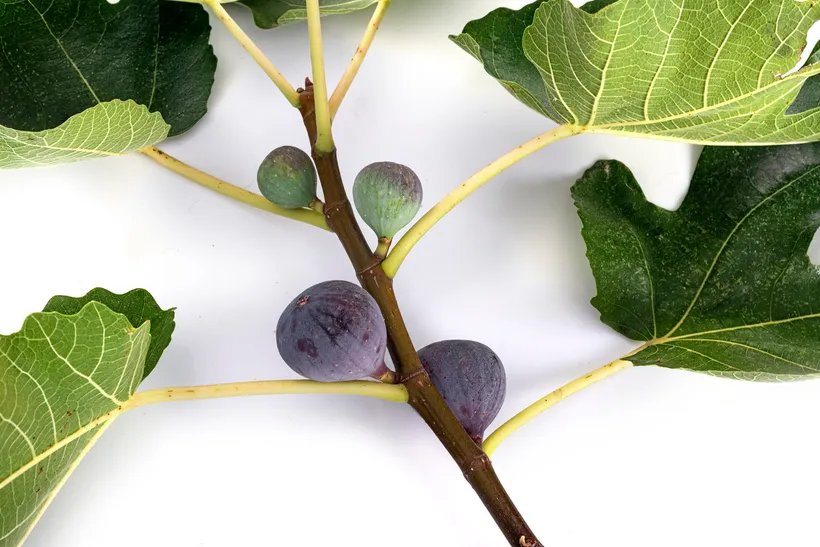
Figs on this year’s shoot, one beside each leaf: the lower ones already ripe, the upper ones still green. Brebas don’t come here, but on the previous year’s wood.
That’s why a fig is pruned differently from almost any other fruit tree. Cutting back the tips of last year’s branches in winter removes the breba buds, even though in January all you can see is bare wood.
Where the breba is before you prune
Winter, no leaves. The top part of each branch is the wood that grew last year, and the buds of next summer’s brebas are already on it.
Two cuts. The left branch is left whole. The right one is tipped, as is often done to “tidy up” a fig tree: last year’s wood goes, and the buds with it.
Summer. The left one gives its brebas on the old wood and then figs on the new shoots. The tipped one puts out vigorous shoots and gives figs, but no brebas that year.
Anyone who tips the whole fig every winter to keep it compact ends up with no brebas, and it’s easy to blame the year or the variety. The tree answers that cut with vigorous shoots that give figs, so the fig crop is usually saved. The breba crop isn’t.
How much to prune: not much
A fig tree doesn’t need pruning to fruit. The University of Florida’s guidance puts it that plainly, and warns that heavy winter pruning can take the following year’s crop. Winter pruning is for something else:
- Remove whole branches rather than shortening them all. Dead ones, broken ones, crossing ones, those growing inwards or drooping to the ground, and suckers from the base. A cut where a branch starts doesn’t touch the tips of the rest, and the brebas stay there.
- If it has to come down, do it in stages. Shorten some branches this winter and others the next. The untouched ones give brebas, and the shortened ones renew themselves and give figs. The following year, the other way round.
- If your fig only gives figs, tipping takes nothing from it, and it can take harder winter pruning. If you don’t know which you have, watch next summer: if in early summer it gives a first batch of large fruit, before the figs, it’s a breba fig.
How much you can take off a tree at once without overdoing it is in how much you can prune a tree.
The old fig tree
It’s another common question: the fig that’s been there forever, has grown huge and fruits where nobody can reach. It regrows strongly from large cuts, so it can be brought down. The price is the crop: the winter it’s cut back hard, the following summer there are few brebas or none.
The sensible approach is to spread it over two or three winters: one year the branches on one side come down, the next year those on the other, and the tree is never left with no fruit at all.
What not to do
- Pollard it, cutting every branch to the same height. It looks compact for a year, with no brebas, and full of long shoots that have to be cut again the following winter.
- Prune it in leaf, in summer or autumn. You lose fruit that’s still ripening and you cut blind, without seeing which branches are surplus.
- Leave stubs. The cut goes where the branch starts, with no stump: a stub sprouts shoots in a cluster, and it’s often where the wood starts to die back.
Gloves and long sleeves, in January too
The white sap a fig tree gives off when cut isn’t harmless. It irritates the skin, and the sap from the leaves and shoots also contains substances that, in sunlight, burn it: 24 to 48 hours later, redness and blisters appear on the skin it touched, and the marks can last for months.
Here you prune in the sun even in the middle of winter, so the risk is there in January too. Gloves, long sleeves and long trousers, and if the sap touches your skin, wash it with soap and water before carrying on in the sun.
If you’d rather we prune it, along with the rest of your fruit trees, see olive and fruit tree pruning.
In short
A fig tree is pruned in winter, without leaves: on the coast, from December to February. If it’s a breba fig, next summer’s breba is already on last year’s branches, and tipping them takes it away. Prune little: whole branches out rather than shortening everything, and if it has to come down, in stages, over two or three winters.
And wear gloves: fig sap, in the sun, burns. How it fits with the rest of the garden is in when to prune on the Costa del Sol.