Blog · Pruning calendar
How to prune lavender: when, depending on which you have, and where to cut
Fringed, Spanish and English lavender flower at different times and are pruned in their own. The cut always goes in the leafy part: from bare wood it barely regrows.
 By Sergio Domínguez6 min read
In October, garden lavender usually looks like this: dry spikes, a base that gets woodier every year and a plant opening up in the middle. The temptation is to cut it right down so it comes back strong, which is what works with almost everything else. With lavender it’s the quickest way to lose it.
There are two questions, and it’s worth keeping them apart. When depends on which lavender you have, because on the coast three are planted that flower at different times. Where to cut, on the other hand, is the same for all of them.
First, which one you have
- Fringed lavender (Lavandula dentata). The leaf edge has little teeth, like a comb. It’s planted a lot on the coast because in a mild climate it flowers almost all year, mostly from autumn to spring.
- Spanish lavender, also sold as French lavender (Lavandula stoechas). The one from the Andalusian hills: a short, fat spike with purple “ears” on top. It flowers in spring.
- English lavender and lavandin(Lavandula angustifolia and its hybrid, lavandin). Smooth, narrow leaves, and long spikes on a thin stem. They flower in summer.
When: right after it flowers
The rule is the same as for almost every flowering shrub: prune when it finishes flowering, so it has time to put out new shoots before the next flush. The reason is in what not to prune in autumn. Applied to October:
- English lavender and lavandin: now is their time, or it was recently. They finished flowering in summer, and on the coast it hardly ever freezes, so an autumn prune doesn’t carry the risk it does in cold places.
- Spanish lavender: its prune was due at the start of summer. If it wasn’t done, just a tidy now: take off the dry spikes and little else. The real one comes when it finishes flowering in spring.
- Fringed lavender: don’t prune it now. It’s starting its best season, and whatever you cut is winter flowers. Keep taking off the spent spikes, and save the big trim for when flowering slows at the end of spring.
Where: always above the bare wood
A lavender with a few years on it only has leaves at the tips. Below that, the stem is grey wood without a single leaf, and every year the green part sits a little higher. That bare wood is the key: lavender regrows poorly from it, and often not at all. Cut there and you’re left with a stick.
Where to cut a lavender
A plant with some years on it. Lavender only has leaves at the tips: further down it’s bare wood, and every year the green part sits a little higher.
Two cuts. On the left, within the leafy part, leaving a little green. On the right, lower down, into the bare wood, to “rejuvenate” it.
Only what had leaves regrows. The one on the left puts out new shoots from what kept its leaves. The one on the right stays a bare stick: lavender regrows poorly from bare wood, and often not at all.
The cut always goes within the leafy part, leaving a little green below it: that’s where the new shoots come from. Take off the whole spike and part of the year’s leafy growth, shaping it into a dome, without ever reaching the wood. Better to fall short than to overdo it: what’s missing can be fixed next year, and what’s overdone can’t.
How it’s done in practice
- A single plant: gather a handful of spikes in one hand, like a bunch of flowers, and cut below them with secateurs, within the leafy part. Work your way round until the plant is rounded.
- A lavender border, like the ones in so many communal gardens: with hedge shears, in one pass, following the same rule. Before you start, look at where the bare wood begins on the oldest plants: that’s the line you don’t cross.
- Clean, sharp tools, so the cut is clean and doesn’t fray the stem.
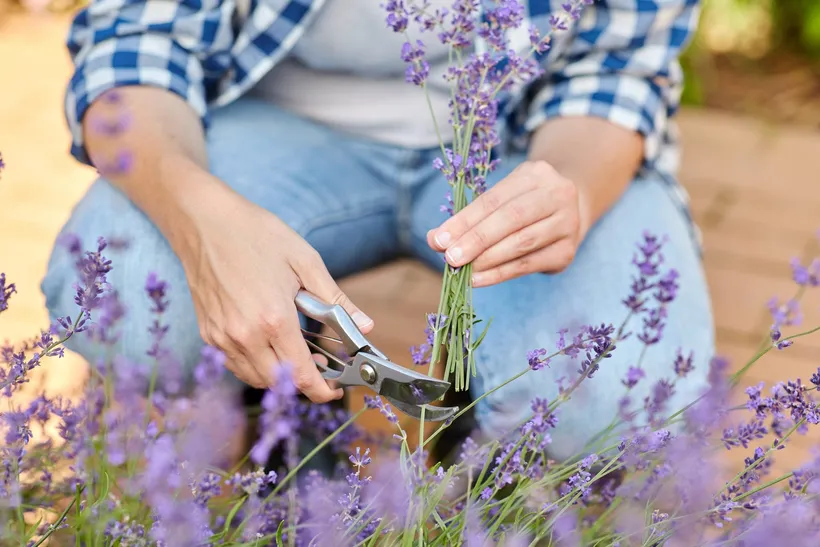
Lavender spikes cut in a bunch with secateurs. When pruning you gather them the same way, like a bunch of flowers, but the cut goes lower: within the leafy part.
If it’s already woody
It’s the question that comes up most, and the honest answer is that a very leggy lavender won’t become a neat dome again. What you can do:
- Look for green shoots lower down. If there’s a leafy shoot on the wood below the top growth, you can cut just above it. That brings the plant down without cutting into bare wood.
- Prune a little every year, always within the green, so it doesn’t keep climbing. It won’t rejuvenate it, but it slows it down.
- Take cuttings and replace it. Autumn is a good time to take cuttings from healthy, leafy tips and root them. A new lavender from a cutting is worth more than an old leggy one, and it’s the same plant.
And if it has suddenly gone grey and dry without being woody, the likeliest cause isn’t pruning but water: lavender is lost far more often to overwatering than to drought. Why, in grouping plants by water needs.
What not to do
- Cut it right down in winter “so it comes back strong”. That works with many shrubs, not with this one.
- Prune fringed lavender in autumn, just as it starts to flower.
- Leave it untouched for years. Every year without pruning the green part climbs and the bare wood grows. A light prune every year is what keeps it compact. Which other shrubs it shares the garden with is in drought-tolerant plants.
If you’d rather we did it, along with the rest of the shrubs in the garden, see hedge and shrub trimming.
In short
When depends on which one you have: English lavender and lavandin now, after the summer; Spanish lavender after the spring; fringed lavender, which on the coast flowers from autumn to spring, at the end of spring, and for now just remove what’s spent.
Where is always the same: within the leafy part, never in the bare wood, because it regrows poorly or not at all from there. And if it’s already very woody, cuttings and a new plant are better than cutting it right down.