Blog · Palms and plant health
Geranium bronze butterfly: why it stays on the coast and what to do
A South African butterfly whose caterpillar eats geraniums from the inside. On the coast it can last the winter, and spraying the outside doesn’t reach it: it’s removed by cutting.
 By Sergio Domínguez6 min read
The geraniums on the balcony have spent all summer putting out buds that never open, and now, in autumn, the stems are bending over or drying out one by one. It isn’t lack of water or a fungus: it’s the caterpillar of a small butterfly, the geranium bronze, which eats the plant from the inside. It’s one of the most common geranium pests on the coast, and October is when it usually shows most.
How to tell it’s the geranium bronze
- Buds with a tiny hole that stay closed and dry up, or flowers that come out chewed.
- Little black pellets, like ground pepper, on the leaves or in the saucer under the pot. They’re the caterpillar’s droppings.
- Stems with a hole that feel soft or hollow when you squeeze them, and end up bending or drying out suddenly while the rest of the plant stays green.
- A small brown or greyish butterfly fluttering around the geraniums in the sunny hours.
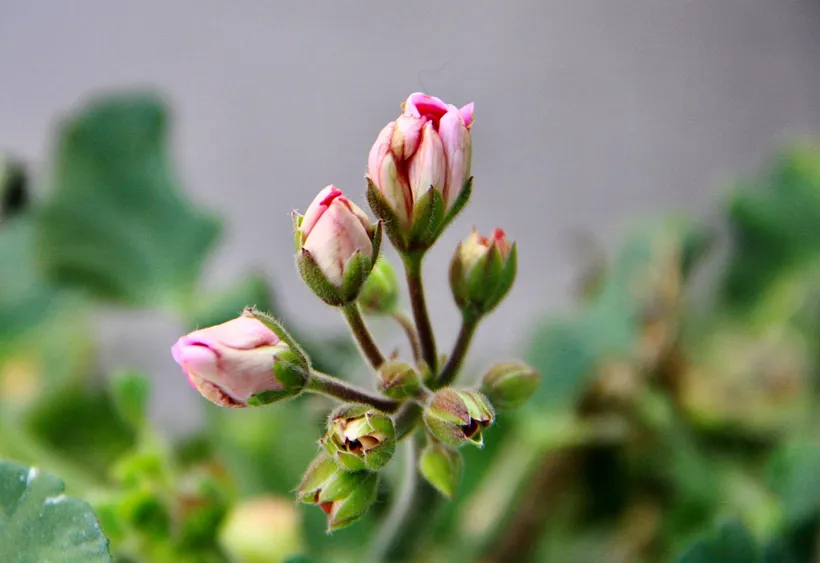
Geranium buds before they open. This is where the butterfly lays its eggs and where to look: a tiny hole in one of them is the first sign of the geranium bronze.
The conclusive test is to split a suspect stem lengthways with scissors: if there’s a dark tunnel inside, and sometimes the caterpillar, greenish and a centimetre or a little more long, there’s no doubt.
What it’s most often confused with:
- Stems that are black and soft from the base, with no hole or pellets: that’s usually overwatering or a saucer left full of water. Unlike the geranium bronze, it starts at the bottom, not the top.
- Buds that dry up with no hole in the middle of a heatwave: the plant drops them because of the heat or lack of water, and puts out new ones as soon as it cools down.
Why it doesn’t go away here
The geranium bronze isn’t from here. It’s a butterfly from southern Africa that reached Mallorca around 1990, probably on imported geraniums, and spread from there across mainland Spain. It travels with the plants: a geranium bought with eggs in its buds brings it to your balcony. Just as the red palm weevil arrived with palm trees, as explained in red palm weevil symptoms.
And here it found what it needs. It has no winter rest, so where winters are cold it can’t survive outdoors. On the coast, with mild winters, it can get through them outside, and as soon as the heat builds it starts again without having to arrive from anywhere. A new generation comes along every month or so, from March to October: five or six a year. That’s why autumn is when it usually shows most: it’s the sum of the whole summer.
In Europe it feeds on Pelargonium, which is what we call geraniums and ivy-leaved geraniums. Hardy geraniums, the genus Geranium with deeply cut leaves, are a different plant, and so far there’s no record of them being a regular food plant in Europe.
Why spraying so often fails
The caterpillar is only exposed at the start, when it hatches and begins on the bud. Once it gets into the stem, whatever is sprayed on the outside no longer reaches it. And because one generation follows another all summer, there are always caterpillars inside even after a treatment.
A geranium stem, from the inside
It lays its eggs by the bud. The butterfly, small and brown, leaves its eggs on or near the flower buds. The newly hatched caterpillar starts by eating the bud, which never opens.
Then the caterpillar gets into the stem. Next it moves into the stem and eats it from the inside. From outside you only see a small hole and some black droppings, and spraying the outside doesn’t reach it.
Cut below it, into sound stem. A stem with a tunnel can’t be saved: cut it below where the tunnel reaches, until the cut comes out clean and solid, and take it out of the garden.
We’re not going to recommend products here. What does matter is understanding that any treatment is aimed at the newly hatched caterpillar, before it gets in, and that once it’s inside the only remedy is removing the stem.
What to do: check, cut and remove
- Check the buds once a week from spring to autumn, and remove any with a hole or that won’t open. Every damaged bud you remove takes a caterpillar with it before it reaches the stem.
- Cut a stem with a tunnel below where the tunnel reaches, until the cut comes out clean, with no hollow and no dark spot. If it’s still hollow, go a little lower.
- Take it out of the garden, in a bag in the bin, not on the pile of garden waste or in the pot next door.
- Check new geraniums before putting them with yours: buds with holes or black pellets on the leaves are a sign it’s come with them.
If you’re taking cuttings this autumn
Autumn is a good time to take geranium cuttings on the coast, and also the easiest way to multiply the geranium bronze. Before rooting a cutting, look at the cut end: it should be solid and green inside. If there’s a hollow or dark spot in the middle, that stem has a tunnel and is no good.
And if a plant has nearly every stem affected, sometimes the sensible thing is to cut the whole plant back low and let it regrow from the base, or to keep a couple of clean cuttings and start again. How to tell whether what’s left is alive is in how to tell if a plant is dead.
What about changing plants?
If a balcony fills up with geranium bronze every year, one way out is not to have it all in geraniums. The butterfly is looking for Pelargonium; a balcony with other flowering plants, and the geraniums spread out, gets checked sooner and loses less. If you’d rather we checked it along with the rest of the garden, see garden maintenance.
In short
Buds that won’t open, black pellets and stems that bend over hollow: it’s the geranium bronze, a butterfly that on the coast can get through the winter outdoors and that by autumn has added up the damage of the whole summer.
The caterpillar lives inside the stem, so spraying the outside comes too late. What works is removing damaged buds every week, cutting stems below the tunnel until you reach sound stem, taking them out of the garden and not taking cuttings from hollow stems.