Blog · Mediterranean garden
Brown in September doesn’t always mean dead
Half a dozen brown plants and the temptation to pull them all out before replanting. Here that’s done in October, not now: several of them aren’t dead, they’re dormant.
 By Sergio Domínguez8 min read
September in the garden looks a lot like a casualty count. Half a dozen brown shrubs, a bush without one green leaf, and the feeling that the summer has taken out half the bed.
What everyone does next is dig them out, to leave it clean before replanting. And this is where it pays to wait a little.
In this climate, brown doesn’t mean the same thing
This is the part that changes depending on where you are, and it’s why the advice in a general manual fails here.
In a climate with hard winters, the blow that kills most plants is the cold. A plant that’s still brown in September has had all spring and all summer to respond, and it hasn’t: it’s most likely dead.
Here the blow is the opposite one, and it’s recent. What has punished that plant is the last two months, and a good part of Mediterranean flora has a very specific response to extreme heat: shutting down. It drops its leaves to stop transpiring, stops growing, and waits for the nights to cool.
From the outside that looks exactly like being dead. From the inside, it isn’t.
The fingernail test
The answer isn’t where you’re looking. It’s a millimetre under the bark, and you can see it in a second.
The same stem, before you dig it out
After August, a lot of plants here look like this. Brown leaves, crunchy branches and not a single shoot. Seen from above, the case looks closed.
The check takes a second and needs nothing. With your fingernail, scratch a small piece of bark off a main branch — or off the stem, near the ground. You don’t have to cut anything.
If there’s green underneath, the plant is alive. It’s dormant, which is something else: it shut down in August to save itself and starts again when the nights cool. If it’s brown and dry inside, that branch really is dead — test lower down before you give up.
With your fingernail or the tip of a pair of secateurs, scrape a small piece of bark off a main branch: if green shows, it’s alive. If it comes out brown and dry and crumbles, that branch is dead, but that doesn’t condemn the plant. Repeat the test lower down, and then on the main stem near the ground. It’s very common for a shrub to have lost its tips and kept its whole base alive: that isn’t a dead plant, it’s a plant that needs pruning.
The other test, which is even easier
Pull gently on the plant at the base, as if you were going to take it out. If it gives without resistance, there’s no root, and then it doesn’t matter what the bark says. If it’s firmly anchored, the root is still there, working.
Between the two tests — bark and anchorage — the great majority of cases are settled without having to wait for anything.
Which ones are usually dormant and which are usually dead
No fixed lists, because it depends on the particular species, the age of the plant and how the summer went. But there’s a pattern that works as a guide.
The ones from here tend to shut down. Anything with small, hard or greyish leaves — aromatics, scrubland shrubs, many silver-leaved plants — is built precisely to survive a summer like this, and the way it does so is by dropping leaves. Those deserve the fingernail test without fail, and they almost always show green. Which they are and why they cope, we cover in drought-tolerant plants.
The ones from another climate tend not to come back. Big, soft, deep-green leaves mean that plant was designed for somewhere with water in summer. When those dry out, they’ve usually dried out for good.
And there’s an in-between case that confuses a lot of people: the plant that has lost everything above ground but regrows from below, from the base or from the root itself. At first nothing shows and it looks dead; weeks later new shoots come up at its foot. That’s why it’s worth looking at the soil around the stump before writing anything off.
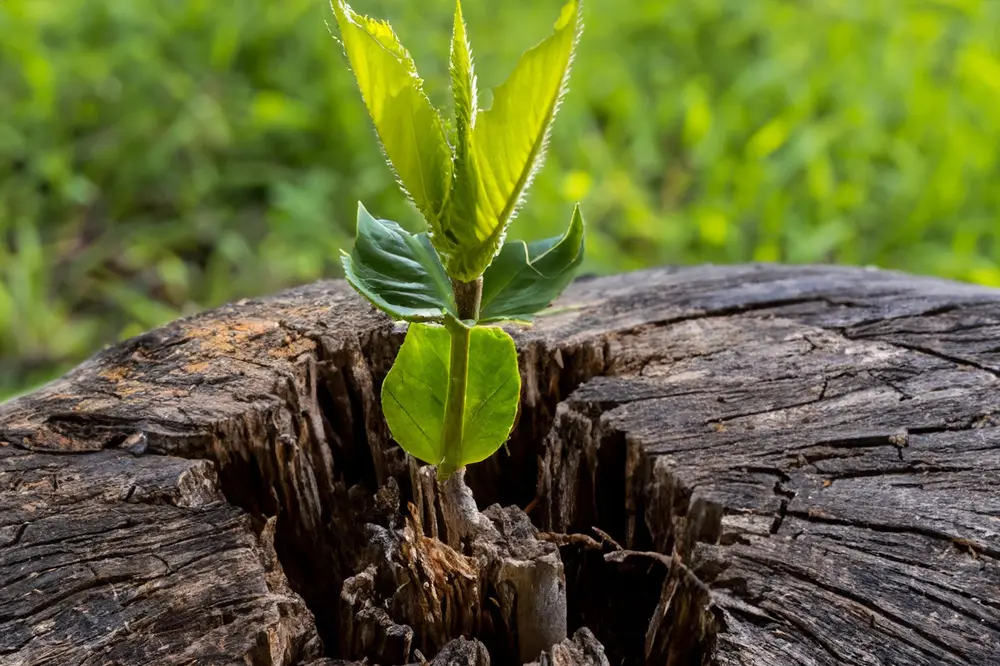
That wood has looked like this for a while and isn’t going to get any better. What was alive was the root, and until the shoot came out there was no way of telling from above.
What to do while you decide
Don’t prune yet anything you’re not sure is dead. Those dry branches are acting as a parasol over what’s still alive, and in September that’s still worth something. They’re cleaned up once the regrowth shows and you know how far to cut.
Water as if it were alive, but don’t overdo it. Moderate, steady watering is what gives it the chance to get going. A deluge on a dormant plant doesn’t wake it sooner: it rots the root, which is all it has left.
And give it until October. What triggers the regrowth isn’t the calendar, it’s the first rains and, above all, the cool nights. Once they arrive and two or three weeks go by, whatever hasn’t stirred won’t.
And then, yes, replant
That wait costs nothing, because the time to plant here isn’t September anyway: it’s autumn, when the soil is still warm and the sun no longer bites. So digging out now doesn’t bring the work forward, it only brings the decision forward (we explain it in why here you plant in autumn).
When the time comes, what is worth doing is asking yourself why what died, died. If a plant has dried out two summers running in the same spot, the problem isn’t the plant.
Sometimes the honest conclusion is that the bed is badly planned for the way it faces, and that replacing like with like is paying twice — in landscaping and garden design we explain how that’s decided.
In short
Before you dig anything out, scrape a bit of bark and pull gently at the base. It’s ten seconds a plant, and on this coast it saves quite a few more than you’d imagine.
Whatever is dead will still be dead in October, and by then you’ll also have seen which ones regrow. Nothing is lost by waiting, and something is lost by digging out.