Blog · Palms and plant health
The palm borer moth: the palm pest that isn’t the red palm weevil
A large moth with orange hindwings whose larva bores into the palmito, the Chusan palm and the Canary palm. It leaves arcs of holes in the leaves and fibre plugging the trunk, and it isn’t the weevil.
 By Sergio Domínguez6 min read
The palm borer moth (Paysandisia archon) is a large moth from South America whose larva lives inside palms and eats them from within. It reached Europe in imported palms, is now considered widespread along the whole Mediterranean coast, and the UK government’s plant health factsheet already places it as far west as Gibraltar. This coast sits in between.
Here, when a palm starts looking poorly, people think of the red palm weevil, and with good reason. But not everything that eats a palm is the weevil, and the palm borer moth goes hard for fan palms, starting with the palmito.
What it looks like
The adult flies by day and is hard to miss: it measures nine to eleven centimetres from wingtip to wingtip, with brown forewings and orange hindwings with a black band and white patches. It flies in summer. In France it’s seen from mid-May to September, peaking in June and July; in the Valencia region they give the flight and egg-laying period as April to November.
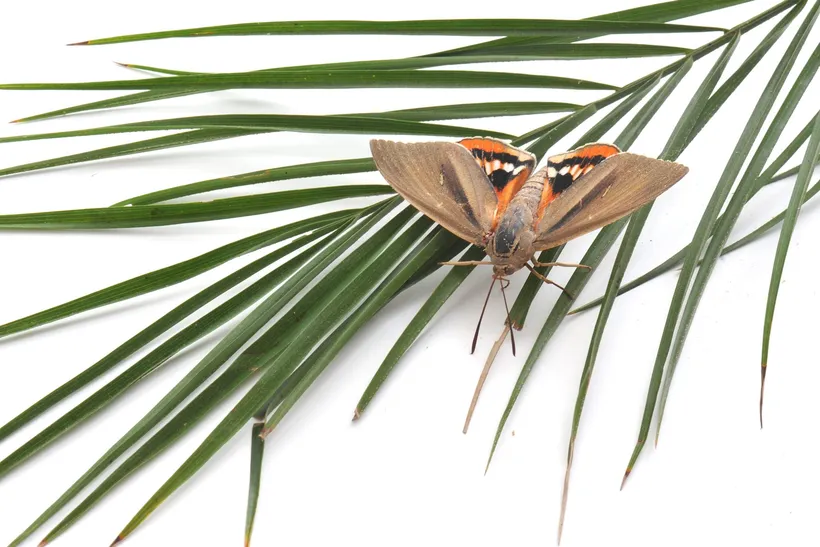
The adult palm borer moth. The brown forewings cover the hindwings almost completely; the orange with white patches is what you see when it opens them or takes off.
But the moth is the least of it. It lays its eggs, which look like grains of rice, among the fibres of the trunk near the crown. What does the damage is the larva: white, it grows to six to nine centimetres and spends one or two years inside the palm, boring tunnels down the trunk.
Which palms it attacks
According to the Valencian regional government, the most susceptible are the palmito (European fan palm), this coast’s native palm, and the Chusan palm (Trachycarpus), the fan palm with the hairy trunk. After them come the Canary Island date palm and the date palm. And, to a lesser extent, Washingtonias, the queen palm and other garden palms. In other words, almost every palm on an urbanisation on the coast.
And the damage is not minor. The tunnels can be over a metre long and cut off the flow of water up the trunk. And a palm has only one bud, the one in the heart: if the larva reaches it, it can’t regrow from anywhere else. It has caused havoc in nurseries in southern Europe; in the French region of Languedoc-Roussillon up to 90% of Chusan palms were lost between 2002 and 2012, according to the UK factsheet.
How to recognise the damage
- Matted, hard fibre, or sawdust, plugging holes in the trunk. According to the Valencian regional government, this is the most visible symptom: the larva’s trace at the mouth of its tunnels.
- Round holes in a row or an arc across the leaves, especially on fan palms.
- Central leaves that yellow and dry out, and sometimes a trunk that starts to lean.
- Remains of the pupa, the empty case the adult leaves behind when it emerges, sticking out of the trunk or at the base of the leaves.
And often, nothing. Symptoms show up late, and a palm can have larvae inside without anything showing.
The row of holes is the most striking sign, and the most misleading: it looks like the work of something that came to eat the open leaf, and it isn’t.
Where the row of holes comes from
In the heart. The new leaf comes out of the centre folded, like a closed fan. The newly hatched larva feeds on that tender leaf and bores through it, with all the folds together.
The leaf opens. As it unfolds, the hole shows up repeated in every fold.
Open. What’s left is a row of holes in an arc, all the same distance from the centre. By then the larva has gone down into the trunk, which is where it does the serious damage.
Red palm weevil or palm borer moth?
The UK factsheet warns that the symptoms can be confused, and it’s no surprise: both are palm pests, both eat the tender leaf in the centre and both leave sawdust and fibre. The clues that help tell them apart:
- The insect. The weevil is a reddish beetle two or three centimetres long. The palm borer moth is a large moth that flies by day in summer.
- The leaves. The weevil leaves the central ones notched or with the tips eaten, as if snipped. The moth leaves round holes in a row.
- Where the damage is. The weevil’s is mainly in the heart. The moth works its way down the trunk, and the fibre plugs appear along it.
- The palm. The weevil goes mainly for the Canary Island date palm. The moth goes for that one too, but above all for the palmito and the Chusan palm.
No single clue is enough on its own. If in doubt, have it looked at by someone who can tell one pest from the other, because they aren’t treated the same way. The weevil, sign by sign, is in red palm weevil symptoms.
What to do
- Look at your palms in summer, when the adult is flying and can be seen, and check the trunk and the new leaves the rest of the year.
- Treatment is a job for a professional. Chemical treatment struggles to reach a larva deep in the trunk. Preventive treatments are applied during the flight and egg-laying season, with products authorised for parks and gardens, by someone with an applicator’s licence.
- If the attack is severe, the palm is felled, and the remains aren’t ordinary prunings: they’re destroyed, ideally shredded at a facility set up for it.
- When you buy a palm, check for the plant passport. It’s the label that guarantees it comes from a registered nursery and has been through its checks. The pest travels inside infested palms that are bought and moved, as well as by flying.
It’s also on Spain’s official list of invasive alien species. And checking the crown goes with pruning: if you’d rather we looked at it, see palm tree pruning.
In short
The palm borer moth is a large moth with orange hindwings whose larva bores through palms from the inside for one or two years. It attacks the palmito and the Chusan palm above all, and the Canary Island date palm too.
You recognise it by the fibre and sawdust plugging holes in the trunk, and by the arc of holes in fan palm leaves, which were all made at once, while the leaf was still folded. It isn’t the red palm weevil, and it isn’t treated the same way: if you see it, have it looked at before cutting anything.