Blog · Mediterranean garden
Bougainvillea not flowering: it’s too well looked after
It’s huge, green and lovely, and won’t produce a single flower. It’s almost never lacking anything: it lacks nothing, and for this plant that takes away the urge to flower.
 By Sergio Domínguez8 min read
Your neighbour’s is a purple wall and yours is a green hedge. Same street, same aspect, and you water and feed yours, while he pays his no attention at all. And that’s exactly the problem: you look after it and he doesn’t.
First things first: the coloured parts aren’t flowers
It’s worth clearing up, because everything else follows from it. The purple, fuchsia or orange of a bougainvillea aren’t petals: they’re leaves. They’re called bracts, and they’re modified leaves that the plant colours so they’ll be seen. The real flower is the little white or yellow trumpet in the middle, the size of a lentil, and nobody looks at it.
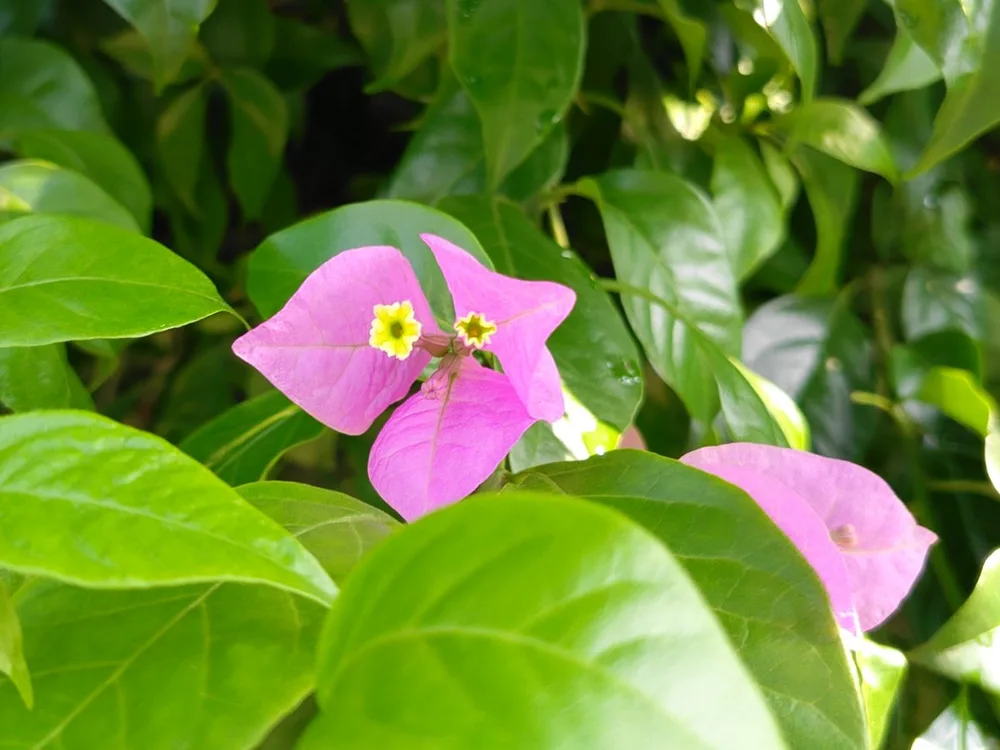
The three pink pieces are bracts — leaves — and the two real flowers are the little trumpets in the middle. Around them, ordinary leaves of the same plant. It’s the same part, painted another colour.
And why does it matter? Because if the colour is a leaf, it forms where leaves form: on new growth. It isn’t a flower the plant prepares separately from its reserves. It’s what the tip of a stem does when it decides it isn’t going to get any longer.
Here it flowers when it’s having a slightly hard time
Bougainvillea comes from dry places and has learnt to behave accordingly. As long as it has water and food to spare, it does what any plant that can afford it would do: grow. New stem, new leaf, and again. It’s in no hurry to reproduce, because it’s doing fine.
When water starts to run short, the shoot stops stretching. And it’s just then, at the tip of that stalled shoot, that the colour appears. Put the other way round, which is how it makes sense: a bougainvillea that never stops growing never gets round to flowering.
The same stem, from start to finish
With water to spare, it grows. Everything the plant makes goes into new stem and leaf. It’s growing, it’s healthy and it looks lovely, and it has no reason to do anything else.
When the water drops, it stops. The stem stops lengthening. It isn’t dying: it has stopped investing in growth, and that frees up what it was spending on it.
And that’s when it colours up. The bracts come out at the tip of the shoot that has stopped. That’s why a bougainvillea watered like the lawn stays green: it never gets to stop.
Feeding works the same way, only more so. Nitrogen — what makes a lawn green and lush — is precisely the “keep growing” order. A well-watered bougainvillea fed plenty of nitrogen is a leaf-making machine, and it works perfectly. It just isn’t what you planted it for.
And here the watering isn’t yours: it’s the garden’s
This is the local part, and it explains why it happens so much on this coast. A bougainvillea is hardly ever on its own in a pot with its own watering. It’s in the bed around the lawn, running off the same irrigation controller, or climbing the wall of an area that’s all watered on the same zone.
And a lawn on this coast gets watered a lot and often, because otherwise it dies. So every day from May to September, the bougainvillea gets the watering designed for a plant that needs exactly the opposite of what it needs. On top of that, when the lawn is fed, some of that nitrogen ends up at its roots, which are under the same patch.
You can check this in two minutes, with no tools. Look at which dripper or sprinkler waters your bougainvillea. If the answer is “the same one as the lawn” or “the same one as the whole bed”, you have your diagnosis, and there’s no need to look any further.
What to change, and why now
- Take it off the lawn’s watering. It’s the only thing that fixes the underlying problem. If the zone can’t be split, you can cap its own dripper and let it live on whatever reaches it second-hand: in soil like ours, an established bougainvillea copes with far more than people think.
- Let it dry out between waterings. It isn’t about killing it with thirst, but about letting the soil genuinely dry out before the next watering. That swing is the signal the plant is waiting for.
- Cut out the nitrogen. If you feed the lawn underneath it, you’re feeding the bougainvillea too. And if you do give it fertiliser, make it one for flowering, not one for growth.
- Pruning helps, because it forces new growth. Every new shoot that stops is another flush of colour. A bougainvillea that’s never touched ends up flowering only at the very top, which is the only part still renewing itself.
- And in pots they flower better, unfair as it seems. It isn’t that the pot has anything magic about it: it’s that in a pot the plant runs out of water on its own every few days. What happens to it there is what you have to bring about by hand in the garden.
The now makes sense for two reasons. One, in September you have to adjust the irrigation controller anyway, because the August programme is too much for September. And two, there’s still some season left: a shoot that stops in the next few weeks will get to colour up before it turns properly cool. How to tell how much water a plant is really getting is covered in how much to water in summer.
When something really is wrong
It isn’t always too much care. There are three cases where the plant has a real problem and changing the watering won’t fix anything:
- It’s in the shade. It’s the one failing that nothing can make up for. A bougainvillea needs direct sun, and plenty of hours of it; in partial shade it lives, grows and never flowers. If yours is under a tree or on a wall that only gets the sun for a while, that’s the reason, and the fix is to move it.
- It was planted recently. The first year, or the first two, it puts into making roots. That’s normal and there’s nothing to do but wait.
- Its roots were disturbed. A transplant, a trench alongside, building work. It takes it hard and is slow to get back to its usual self.
And one thing that isn’t a problem: going half bare in winter. It doesn’t usually freeze here, but in the cold it drops leaves and stops, and that’s what it’s supposed to do. What is worth doing is not taking the secateurs to it at the wrong time: some plants aren’t pruned in autumn precisely because it takes away their next flowering.
In short
A bougainvillea’s colour is leaves, and they come out at the tip of a shoot that has stopped lengthening. That’s why it flowers when it’s a little thirsty and stays green when it lacks nothing. In gardens here the culprit is almost always the lawn’s watering, which reaches it second-hand every day, plus the nitrogen from that same lawn’s feed. Take it off that watering, let the soil dry out between one and the next, and cut out the nitrogen. If it still won’t flower, check its hours of sun: that’s the one thing watering less won’t fix.