Blog · Vertical gardens
Before the vertical garden: whose wall it is and how much it weighs wet
Everyone starts with the plants. In a block of flats there are two things that come first, and both are settled with a phone call, not a catalogue.
 By Sergio Domínguez8 min read
The conversation about a vertical garden always starts in the same place: which plants. And that’s the last thing to decide.
In a block of flats, which is most of what there is on this coast, there are two questions that come first and don’t sound like gardening at all. Both are settled with a phone call, not a catalogue, and both are best asked before you pay for anything.
First: is that wall yours?
It sounds like a silly question until you look closely. In a flat or a penthouse, the wall facing the street is usually façade, and the façade is a common element: it belongs to the owners’ community, not to you. The terrace parapet, the partition with the neighbour and the wall of the drying area may be too, or not, depending on the building.
The important thing is that you can’t tell by looking at it. Having exclusive use of the terrace doesn’t make everything around it yours, and the split between what’s common and what’s private changes from one building to another, depending on what its deeds and statutes say.
So the question goes to the property administrator, and it’s one phone call: what counts as a common element in your case, and what it takes to fix something there. The answer shapes everything else — if the wall isn’t available, the whole system changes: there are solutions that stand on their own frame, resting on the terrace floor, and don’t touch the wall.
And it’s worth asking before you buy. A vertical garden that’s already installed and has to come down isn’t just the money: it’s the wall with the holes already drilled.
Second: how much does this weigh when it’s wet?
This is the point nobody believes, and it’s the reason this question exists. A vertical garden is bought from a photo, and in a photo it weighs nothing: you see plants, and plants weigh little.
What hangs from the wall isn’t the plants. It’s the growing medium with the water in it, plus the structure, plus the irrigation system itself. And the growing medium is almost never dry.
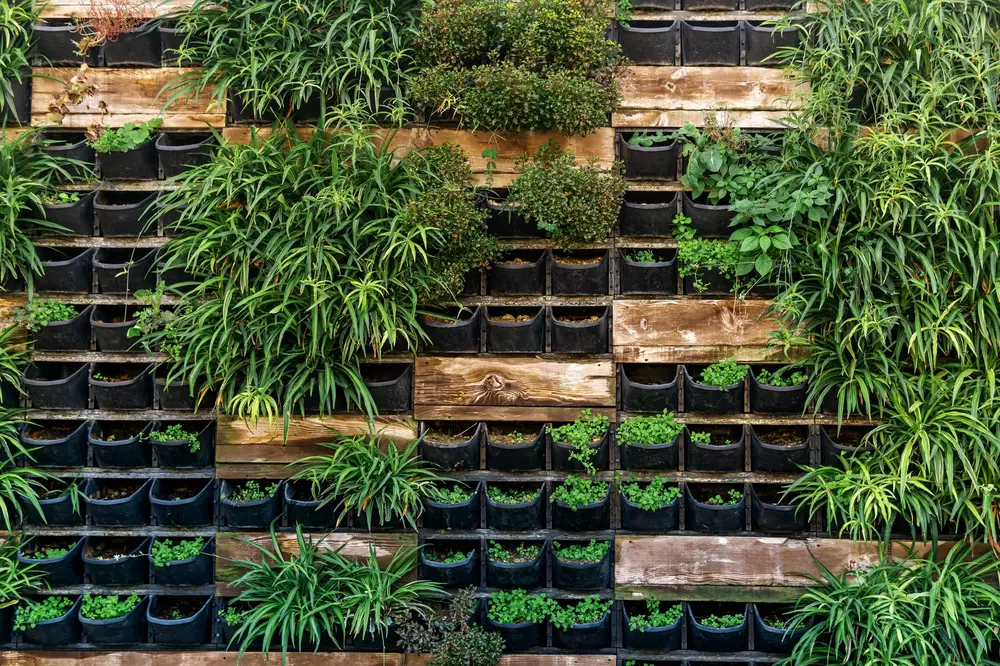
Once the garden is finished you don’t see any of this. What hangs from the wall is those rows of containers with their soil inside, and the plants are the top layer — the one you choose, and the one that weighs least.
The same panel, one full watering
The panel they show you is dry. It’s the state it’s transported, photographed and installed in, and it’s the lightest it will ever be.
With each watering the growing medium fills with water. And while the water is inside, it hangs from the same fixings. What the wall carries at that moment has nothing to do with what the plants weighed.
The excess drains off and it stays damp. A growing medium holds water between waterings — that’s what it’s for — so it never goes back to the weight in the photo. This is its normal state, and it’s the one to ask about.
This isn’t a technical detail: it’s the difference between the figure you’re given and the one the wall will be carrying every day of the year. Always ask for the wet weight, not the weight of the system, and if you’re given a single number, ask which of the two it is.
On a west-facing penthouse the problem gets worse where you least expect it. A wall that radiates heat from behind means more watering, and more watering means more water held for more hours. The aspect that makes the plant suffer is the same one that makes the fixings work. Why the wall rules over the species is covered in vertical gardens.
What you can sort out yourself before calling
Check which way the wall faces and what time the sun reaches it. That alone rules out half the plant palettes, and it’s something you know without anyone coming round.
Check what’s on the other side. A solid wall isn’t the same as a lightweight wall or a bedroom partition. You’re hanging a permanently damp system against something, and knowing what that is changes the solution.
Check where the nearest water supply and drain are. A vertical garden needs both: water goes in and water comes out. If the terrace has no drain, or it’s far away, that isn’t an insurmountable problem, but it is part of the quote, and it’s better to know beforehand.
And check whether there’s a socket. Almost all systems have a pump and a controller. It sounds obvious, and it’s one of the things that turn up halfway through the installation.
The awkward question: does it have to be vertical?
It’s worth asking, because the honest answer is sometimes no. A vertical garden is the solution when there’s no ground available but there is a wall. If there’s a metre of ground at the foot of the wall, a climber planted in the soil does the same visual job without depending on a pump, without hanging weight from anything and without a power cut in August taking the garden with it.
And if what you’re after is covering a party wall or a view, it’s worth looking first at what can be planted in front of it: the right hedge solves many of these cases with far less maintenance. We cover it in which hedge to plant on the Costa del Sol.
If it’s in a communal area, who decides changes
Everything above applies to your terrace. If what’s being considered is a vertical garden in the entrance hall, the garage or a communal courtyard, the owners’ meeting decides and the community pays, and that changes how you ask for it.
What’s most often forgotten in that case isn’t the installation: it’s who maintains it afterwards, and how often. A system like this doesn’t take generic maintenance, and if it isn’t written into the contract it isn’t contracted — we cover it in what to look for in the community’s gardening contract.
In short
Before choosing a single plant there are two calls to make: one to the property administrator, to find out whether that wall can be touched, and another to whoever is going to install it, so they can tell you how much the system carries with the growing medium wet.
Both are free and both can be made this week. And both avoid the same thing: discovering the problem when the garden is already hanging.