Blog · Mediterranean garden
When to plant tulips on the Costa del Sol, and why they go in the fridge first
Planted in October, as inland, they give leaves and a low flower or none. Here you buy them now, give them weeks in the fridge and plant them in December.
 By Sergio Domínguez6 min read
Inland, tulips go in in October or November and are forgotten about until spring. On the Costa del Sol, done the same way, what you usually get is leaves and a short flower tucked down between them, or none at all. Here the answer has two parts: buy them now, give them a few weeks in the fridge, and plant them in December or early January.
It sounds like a magazine trick, but it’s what agricultural extension services recommend in places with mild winters, such as Florida. The reason is inside the bulb.
Why tulips need the cold
Tulips come from mountains with hard winters, and it’s built into them: when you buy one, the flower is already formed inside the bulb, but the stem won’t stretch until it has been through a winter. Trials with bulbs of the Apeldoorn variety put numbers on it: with twelve weeks at 5 °C before planting, they grow and flower properly; without that cold, the shoot grows far less and the flower is often aborted.
On the coast that cold never arrives. At Málaga airport, January, the coldest month, averages 12 °C with an average low of around 7 °C, according to AEMET’s climate normals. There are cold nights, but the soil doesn’t sit at the temperature the bulb needs for weeks on end. That’s why the cold is given before planting.
Why tulips go through the fridge
October: two identical bulbs. The one on the left goes into the ground straight away, as it would inland. The one on the right spends a few weeks in the fridge first.
The winter that never comes. On the coast the winter is mild, and the soil doesn’t give the bulb the cold it needs to stretch its stem. The one on the right gets it in the fridge.
Spring. The fridge bulb, planted in December, stretches its stem and flowers up high. The other stays in leaf, with a low flower tucked between the leaves, or none at all.
How long in the fridge, and how
Sources don’t agree on a single figure, because each variety asks for its own. The University of Florida extension service, which has the same problem we do, talks about two to four months of cold. To be on the safe side at home, allow ten to twelve weeks. Any less and the stem comes out shorter.
- In the salad drawer, not the freezer: the idea is to chill them, not freeze them.
- In a paper or mesh bag, so they can breathe. In a sealed plastic bag, moisture condenses and mould sets in.
- With no fruit nearby. Apples, pears and other fruit give off ethylene as they ripen, a gas that damages the flower inside the bulb. It may then fail to flower even though it looks healthy. If the fridge is full of fruit, use another one.
Doing the sums: put them in the fridge in mid-October and they come out between Christmas and early January, which is exactly when they should go in the ground. Some suppliers sell them already chilled for warm climates. If so, the cold is done and they go straight in when they arrive.
Where and how to plant them
- Pointed end up, at a depth of two to three times the height of the bulb.
- In full sun, or where the sun reaches for most of the day.
- In soil that doesn’t waterlog. It’s what loses the most bulbs: in heavy, wet soil they rot before they sprout. If the garden is clay, better in a pot or in a bed with the soil lightened.
- One watering at planting, then little. It rains in winter, and until the leaves come up the bulb hardly drinks.
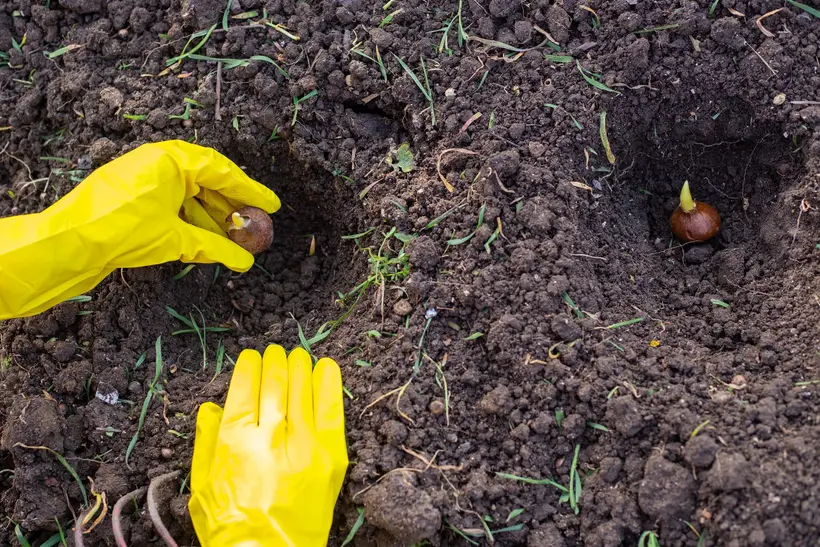
Each bulb in its hole, pointed end up. On the coast, this happens in December or early January, after the fridge.
They do very well in pots. You put them where they can be seen, you control the watering and, when they’re over, they come out without leaving a gap in the garden.
Next year: they rarely come back
It’s the part nobody mentions when selling them. In a climate like ours, tulips flower once, and the usual thing is that the following year they don’t flower again, or give a much poorer show. You can lift them once the leaves have died back and repeat the fridge in autumn, but the result tends to be weak.
The practical approach is to treat them as seasonal flowers, like summer petunias: plant them, enjoy their flower in spring and replace them the following year.
Bulbs that do stay on the coast
If what you want is to plant once and have them come back every year, there are bulbs made for this climate. None of them needs the fridge, and they go in now, in autumn:
- Paperwhite narcissus (Narcissus papyraceus). It grows wild in Andalusia and flowers in the middle of winter, with clusters of very fragrant white flowers. Left in place, it gradually spreads.
- Freesias. They come from South Africa, from a climate much like ours: they sprout with the autumn rains, flower in late winter and spring, and in summer they die back and rest. What matters most is not watering them in summer, while they’re dormant.
For other plants that flower from November to March near the sea, see winter-flowering plants. And for why autumn is the best time here to plant almost everything, see when to plant on the Costa del Sol.
In short
On the coast, tulips aren’t planted in October as they are inland. Buy them now, give them ten to twelve weeks in the salad drawer, in paper and away from fruit, and plant them in December or early January, in the sun and in soil that doesn’t waterlog.
They flower for one spring and rarely repeat, so count them as a seasonal flower. If you want bulbs that stay from one year to the next, the local ones are paperwhite narcissus and freesias.