Blog · Artificial grass: buying decisions
Artificial grass on a terrace: what’s underneath that you can’t see
You can, and on this coast it’s where a good share of it goes. But the waterproofing is underneath, it isn’t drilled, and on a penthouse the water, heat, wind and salt matter too.
 By Sergio Domínguez6 min read
You can, and on this coast it’s where a good share of artificial grass goes: terraces, penthouses and roof terraces. But a terrace isn’t a garden. There’s no soil underneath: there’s the waterproofing of your home, and often of the home below.
So what decides whether it turns out well isn’t so much which grass you buy as how it’s laid. And there’s one rule with no exceptions: on a terrace, the grass isn’t nailed or screwed down.
What’s underneath: the membrane
Under the tiles of a terrace or a roof terrace there’s a waterproof membrane. It’s what stops rainwater getting into the slab and the ceiling of the flat below. You can’t see it, and nobody thinks about it until it fails.
And in a building it isn’t only yours. The Spanish Civil Code lists roofs among a building’s common elements, so a terrace that is the roof of another flat usually counts as one even if only you use it. Anything that affects it is also a matter for the owners’ community.
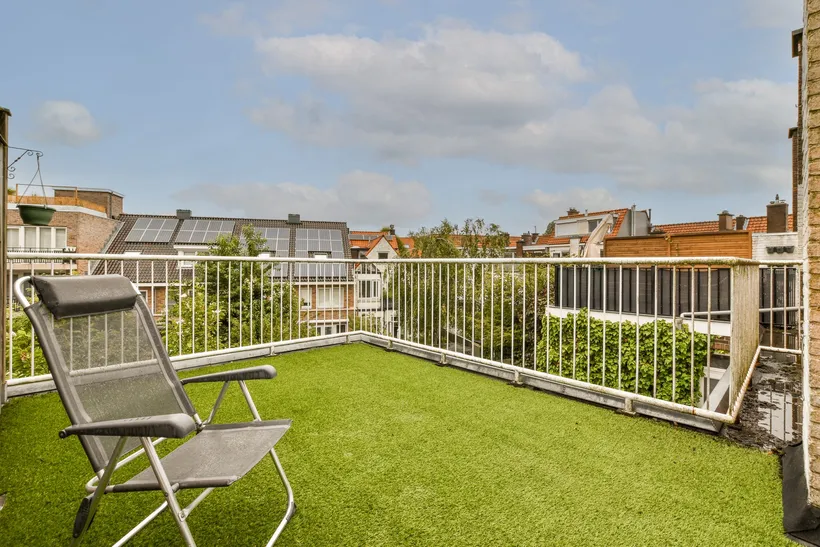
Grass laid on a roof terrace. On the right, where it ends, you can see what’s underneath: the roof, with the water and dirt that gather along the edge.
That’s why the grass isn’t fixed with nails or screws. A screw goes through the tile, the screed and the membrane, and leaves a way in for water that the grass itself covers up. Penetrations are, along with seams and drains, among the usual places where leaks get into a flat roof.
Why grass on a terrace isn’t screwed down
Laid properly. Water passes through the holes in the grass and runs over the tiles, down the slope, to the drain. The waterproof membrane underneath doesn’t even get wet.
A screw to hold it down. So that the wind doesn’t lift it, it’s screwed to the floor. The screw goes through the tile, the screed and the membrane, and the grass hides it.
With the first heavy rain. Water gets in through that hole and can run along the top of the slab before it comes out. The stain appears on the ceiling below, sometimes a long way from the screw.
And the leak doesn’t show up under the screw. On flat roofs, water that gets in can travel a long way horizontally before it appears inside, according to InspectAPedia, the technical reference on building inspection. By the time the stain appears on the neighbour’s ceiling, finding the hole is another job altogether.
So how is it held down? By its own weight, by joining the rolls to each other at the seams so they work as a single piece and, where needed, by gluing it along the edge to the tiles. Never to the membrane, and never glued all over.
Water: the slope and the drains
Above the membrane, water passes through the holes in the grass and runs over the tiles, down the slope, to the drain. What needs looking after is the same as on any roof terrace: don’t build it up to make it all level, leave the drains visible, with a grate you can lift, and don’t glue the grass down all over, because that blocks the holes. We explain it in detail in if artificial grass puddles.
Here the test comes with the first autumn storm, a lot of water in a short time on a drain that has spent the whole summer collecting dust and leaves. What to check beforehand is in the drains, before the first storm.
The heat: check which way it faces
A terrace facing south or west, with nothing to shade it, is the worst place for artificial grass in summer: it gets far hotter than living grass. What solves it is shade, an awning or a pergola. Watering it so you can walk on it doesn’t last and eats up the water saving, which is usually the reason for putting it in. Why it happens is in artificial grass gets hot.
The wind, on penthouses
A penthouse is windy, and on this coast the levante and the poniente can blow hard. Loose grass, in several pieces and with the edge not finished off, is what lifts at the corners. That’s why it’s joined into a single piece and the edge is finished off, which is exactly what tempts people to reach for screws. Don’t: use seams, and glue the edge to the tiles.
Salt and sand, on the seafront
Near the sea, sand and salt reach the terrace, and artificial grass doesn’t clean itself. It gets brushed and rinsed from time to time, and the sand that builds up between the fibres isn’t left there, because it ends up in the drain. How and how often is in artificial grass isn’t zero maintenance. And if there’s a dog on the terrace, see artificial grass for dogs.
And on a balcony
Everything is smaller and the same applies. Nothing screwed down, because there’s someone under the balcony too. And the drain, or the spout that sends the water out, kept clear: the grass is trimmed around it so it doesn’t cover it, because on a balcony water that doesn’t leave that way stays inside, against your door.
What to ask before it’s laid
- How will it be held down? If the answer involves nails or screws, not on a terrace.
- What happens to the drains? They have to stay visible and accessible.
- Is it glued all over, or at the seams and edge? All over blocks the holes the water goes through.
- Is anything being built up to make it level? The terrace’s slope is there to take the water to the drain.
If you’d rather we did it, see artificial grass installation.
In short
Artificial grass can go on a terrace, and go on well. But underneath is the waterproofing, which usually belongs to the community too, and it isn’t drilled: a screw hidden by the grass can end up as a stain on the ceiling below, and a long way from it.
It’s held down by its weight, by seams and by gluing the edge to the tiles. The drains, visible; the slope, as it is. And before you buy it, check which way the terrace faces: if it’s south-facing with no shade, the awning comes first.