Blog · Community green spaces
An urbanisation next to the hillside: the 15-metre firebreak strip and the self-protection plan
What Andalusian rules ask of an urbanisation that borders the hillside: a self-protection plan and a 15-metre strip clear of scrub and grass. The trees stay.
 By Sergio Domínguez6 min read
An urbanisation that borders the hillside has two duties in Andalusia that hardly anyone knows about until they’re needed. Neither is new, and both are better handled by the whole community than neighbour by neighbour: the rules themselves allow for that.
The short answer: if the urbanisation is in a wildfire Danger Zone, it has to have a self-protection plan, filed with the town hall. And it has to keep a safety strip of at least 15 metres around it, clear of debris, scrub and grass. The trees can stay, thinned. Now, with the summer over, is when it gets prepared.
Does it apply to your urbanisation?
Danger Zones (Zonas de Peligro) are declared by the Junta de Andalucía (the regional government), and they cover whole municipalities or parts of them. Málaga’s town hall, for example, says its entire municipal area is one. Around forest land, the law also sets a Forest Influence Zone of 400 metres.
The way to find out is to ask the town hall whether the urbanisation is in a Danger Zone and whether it has a self-protection plan on file. If the answer to the first is yes and to the second no, there’s work to do.
The 15-metre strip
It’s in article 24 of the Andalusian forest-fire regulation, Decree 247/2001: towns, buildings and urbanisations must keep “a safety strip at least 15 metres wide, clear of debris, scrub and herbaceous vegetation”.
What surprises people most is what it doesn’t ask for. It isn’t a bare firebreak, and it doesn’t mean stripping the hillside or removing the trees: the same article allows trees and shrubs to be kept, at the density set in the self-protection plan. What has to go is what burns low down, close to the ground.
The safety strip, side view
No strip. Scrub and grass reach the fence, and the low branches of the pines touch the scrub. The vegetation on the hillside runs, unbroken, right up to the houses.
Fifteen metres without what burns low down. From the edge of the urbanisation, at least 15 metres clear of debris, scrub and grass, which is what the Andalusian forest-fire regulation requires.
The trees can stay. Thinned, to the density set in the self-protection plan. And pruned, with the crown kept clear of the vegetation on the ground and of the houses, as the Junta’s guide recommends.
Two more details from the same article. Owners can group together to protect themselves with a single shared strip, if the land allows it, which in an urbanisation is usually the sensible thing. And the town hall is the one responsible for making sure it’s done.
And “clear of debris” means cutting isn’t enough. Grass that’s been strimmed and left on the ground is still there, dry, and it still burns.
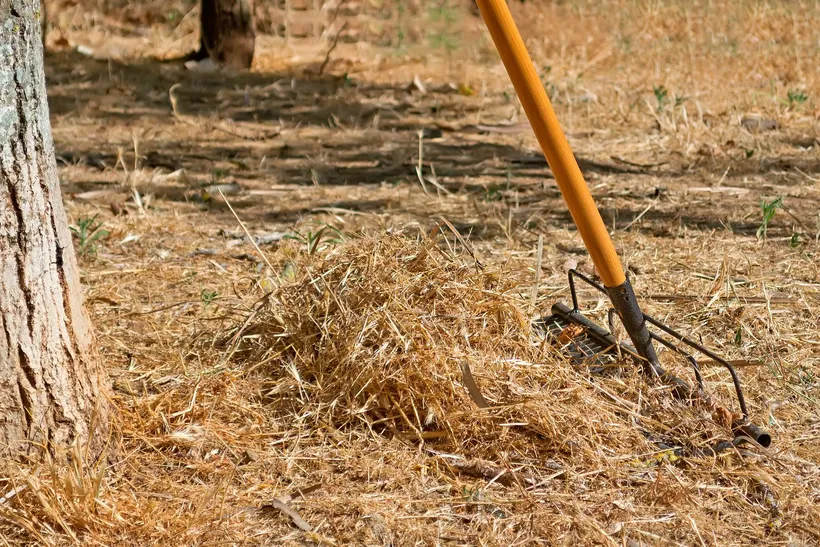
Dry grass cut and raked next to a tree. It isn’t from here. This is how the ground looks after clearing: until it’s taken away, it’s debris.
On top of that, the regulation bans burning that waste in the medium- and high-danger seasons, so the usual thing is to take it away. How clearing is done and what happens to what comes off, in plot clearance.
The self-protection plan
This is the other half, and the one most often forgotten. Law 5/1999 requires it to be drawn up by the owners, collaborating urban management bodies or representatives of urbanisations in Danger Zones. And not having one is an offence under the same law.
At a minimum, the plan covers:
- Its scope: which land and which urbanisation it covers.
- The watch and detection it adds to the local plan’s.
- The equipment and people it has, and how they’re organised.
- The protection measures, how outside help comes in, and the evacuation of the people affected.
It’s filed with the town hall, which approves it and includes it in its local emergency plan. Málaga’s requires it to be drawn up and signed by a qualified technician, and reviewed at least every four years. If nothing has changed, a certificate saying so is enough. Each town hall has its own procedure: it’s worth asking at yours.
What changed in April
Since 9 April 2026, Andalusia’s new Forestry Law (Ley 3/2026 de Montes de Andalucía) has been in force. It repealed the prevention articles of the 1999 forest-fire law, and prevention on forest land itself is now governed by the new law.
For an urbanisation, what matters is what hasn’t changed. Self-protection plans are still in the 1999 law, articles 42 to 44, which the Forestry Law doesn’t repeal. And the new law keeps the 2001 regulation in place, until there’s a new one, wherever it doesn’t contradict it: that’s where the 15-metre strip is.
Inside the urbanisation
The strip is the edge. For what’s inside, the Junta’s quick guide for homes and urbanisations, published by Mijas town hall, recommends this:
- Roads and verges. Private roads, both internal and access roads, kept clear of dry vegetation for a metre either side, and the verges too.
- No dry grass or debris. Not in the communal areas, nor on empty plots, in gullies, along the edges or next to power lines.
- Trees pruned. No dead branches, and the crown kept clear of the vegetation on the ground and of the houses. When a pine is pruned here, in pruning pine trees.
- Hedges and fences on the edge. More fire-resistant species, especially in hedges, and no flammable hedges or fences on the side facing the hillside.
When it’s done
The high-danger season, from 1 June to 15 October, has just ended, and so has the rush. What’s due now is reviewing the plan and deciding who looks after the strip, with time to take it to the community. The scrub and the pruning of the trees along the edge can be done now, without the summer heat.
Grass is a different matter: what’s cut in autumn is tall again by spring. Its pass goes in before the summer, once it has grown and before the danger season starts. Why the two are split, in how much land clearing costs.
What to ask in the community
- Are we in a Danger Zone? The town hall can tell you.
- Do we have a self-protection plan? Whether it’s been filed and approved, and when it was last reviewed.
- Who looks after the strip? Whether it’s the whole community or each owner whose plot borders the hillside, and whose land it falls on.
- Is it in the gardening contract? Whether clearing the strip and pruning the trees along the edge are included, or extra. What else to look at in that contract, in your community’s gardening contract.
In short
An urbanisation in a Danger Zone has to have a self-protection plan filed with the town hall, and a strip of at least 15 metres clear of debris, scrub and grass. The trees can stay, thinned and pruned. April’s Forestry Law hasn’t changed either of the two.
The time to prepare it is now, with the summer a long way off. If you look after the green areas of an urbanisation, what we do there is in communal garden maintenance.