Blog · Artificial grass: buying decisions
Used artificial grass: what a football pitch brings to your garden
It comes from football pitches that have been taken up. It may hold the pitch’s rubber, it has already used up part of its life in the sun, and it’s made for playing. When it works and what to ask.
 By Sergio Domínguez6 min read
It’s advertised as “recycled” or “second-hand” artificial grass, cheaper than new. Nearly all of it comes from the same place: football pitches that have had their turf replaced. And the question is whether that works for a garden.
The short answer: to cover a large area that hardly gets walked on and where looks matter little, it can work. For the garden you see and use, here it has three drawbacks: it may come with the pitch’s rubber inside, it has already used up part of its life in the sun, and it’s made for playing football, not for a garden.
Where it comes from
From pitches being renewed. The sellers say so plainly: one Spanish seller talks of a “permanent stock of turf recovered from football pitches”. They take it up, sort it, cut it into manageable rolls and sell it.
And there will be more of it. The European Union has banned the sale of the plastic infill used on those pitches from 2031, and allowed eight years so that more existing pitches can reach the natural end of their working life before being replaced, as the regulation itself explains. Pitches will be renewed over these years, and some of their turf will end up on this market.
There are two types. Monofilament, with separate strands, and fibrillated, made of tapes split open into a net. One of the sellers recommends the first for gardens and the second for agility, paintball or large shared areas. It shows: fibrillated turf tends to look like a football pitch.
What sits between the fibres
Most garden artificial grass has sand between the fibres. A football pitch also has, on top of that, granules of rubber or another plastic, which cushion the footfall and the bounce of the ball.
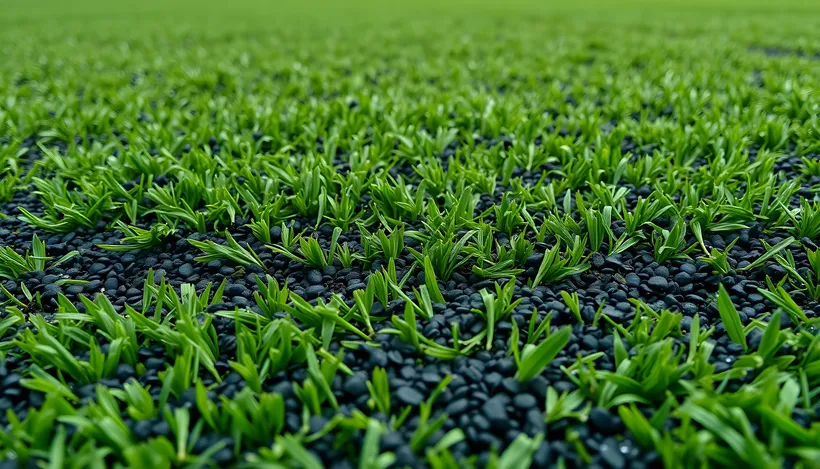
Black rubber granules between the fibres of a sports turf. It isn’t from here. It’s what you can’t see from above when the roll arrives rolled up.
When the turf is taken up, that infill may or may not stay in it. One seller advertises its turf “clean of sand and rubber after the extraction process”, and on the same page notes that “it can also be supplied just as it comes off the pitch, at lower prices”. In other words, with whatever it holds.
A football-pitch turf, in section
On the pitch. Between the fibres of an artificial pitch there is a loose infill: sand at the bottom and, on top, granules of rubber or another plastic, which cushion the footfall and the bounce of the ball.
As removed. Some sellers clean out the sand and rubber, and some sell it as it comes off the pitch, for less. From above you can’t tell: the infill is inside the roll and arrives with it in the garden.
With the first downpour. The infill isn’t fixed to anything. What sits on top moves with the water and with feet, and leaves by the edges and the drains. That is exactly why the European Union bans selling it for pitches from October 2031.
That rubber is exactly what the European Union wants to stop selling. Regulation (EU) 2023/2055 bans the sale of granular infill for synthetic sports surfaces from 17 October 2031, and explains why: it is the largest source of intentionally added microplastics reaching the environment in Europe. It’s loose, and what’s loose leaves with the water.
In a garden here it has two problems of its own. The rubber is black, and in summer it heats up in the sun. Why artificial grass gets so hot, in does artificial grass get hot. And rain here comes all at once, on few days a year: a downpour on a sloping plot washes whatever is loose towards the street and the drain.
The sun it has already had
Artificial grass doesn’t last by the calendar: it lasts as long as the fibre holds up in the sun. A pitch on this coast has spent its years under the 2,905 hours of sunshine a year that AEMET (the Spanish weather agency) records for Málaga, and whatever it has left will be spent under the same sun.
How much is left, nobody knows exactly, and the sellers let it show. On the same website, one section talks of a lifespan of “more than 10 years” and another of “between 5 and 10 years after being taken up from a football pitch”. Neither figure depends on the particular pitch you take home. Where the promised years come from, in how long does artificial grass last.
Made for something else
- The look. Fibrillated turf above all, which looks like a pitch. And it may come with the painted lines: one seller offers its residential turf “without rubber, sand or pitch lines”, which tells you the rest may have them.
- The weight. One seller gives 40 to 60 kilos for each roll it sells for gardens. They have to be carried into the garden, and in a house with steps or a narrow way in, that matters.
- The base. A pitch is built on a base prepared for it, and the turf doesn’t come with it. In your garden the base has to be done just as it would for new grass. What needs to be underneath, in artificial grass drainage.
- Where people go barefoot. With loose rubber in it, better kept away from the pool and from where children or dogs play: it’s walked on barefoot, it heats up and it leaves stuck to feet. What suits those places, in artificial grass around a pool and artificial grass for dogs.
When it does make sense
When what you want is to cover a large area that hardly gets walked on or looked at closely in green: the far end of a plot, an unused side strip, a patch that would otherwise fill up with weeds. Or what the sellers themselves sell it for, an agility or paintball area. There, looks count for little and price for a lot.
In the garden you use every day, the saving has to be weighed against what you don’t know: how many years of sun it has had, what it holds and how much it has left.
What to ask for in writing before buying
- Which pitch it comes from and how many years it was down. If they don’t know, that’s already an answer.
- Whether it’s monofilament or fibrillated, and how tall the fibre is now, not when it was new.
- Whether it’s clean of rubber and sand, or as it was taken up.
- Whether it has painted lines, and photos of the roll you’re getting, not a sample one.
- How it’s delivered and who unloads it. With rolls of 40 to 60 kilos, that’s not a detail.
In short
Used artificial grass is almost always a football pitch that has been taken up. It may come with the pitch’s rubber inside, it has already used up part of its life in the sun, and it’s made for playing, not for a garden. To cover a large area nobody walks on, it can pay off. For the garden at home, ask in writing what you’re getting before you compare prices. And if what you’re after is new grass properly laid, what we do is in artificial grass installation.