Blog · What it costs
Subsurface drip irrigation for a lawn: what makes it cost more, and when it pays off here
It saves water and costs more than sprinklers, because of parts you can’t see. And in the last drought, in Málaga, lawns went unwatered all the same.
 By Sergio Domínguez6 min read
Subsurface drip irrigation has a reputation as the most efficient way to water a lawn, and in terms of water it is. What hardly anyone mentions is why it costs more than sprinklers, which parts it needs that you can’t see, and that in Málaga, in the last drought, watering a lawn with mains water was banned all the same, drip or sprinkler.
The short answer: there’s no honest price per square metre without seeing the garden, but we do know what makes it cost more: a lot of pipe, burying it, drippers protected against roots and three parts you can’t see. It pays off in water and in narrow or sloping areas. But it doesn’t buy the right to water: in the drought, Málaga left lawns out even of survival watering with mains water, however they were watered.
Why there’s no price per metre
Because the square metres of lawn don’t tell you how many metres of pipe go under it. The drip lines run in parallel under the whole lawn, and the distance between them is set by the soil. New Mexico State University’s extension service recommends about 30 centimetres between lines in a sandy soil, and up to about 45 in fine silty or clay soils. A 1994 technical paper for the Irrigation Association, the industry body in the United States, goes from 30 in sand to 60 in clay. In sand, the same lawn can take twice as much pipe. Why we don’t give figures without seeing the job is explained in gardening prices.
Then there’s burying it. In a new garden, the lines are laid before the lawn goes down. If the lawn is already there, it has to be lifted or trenched, and that’s a different job.
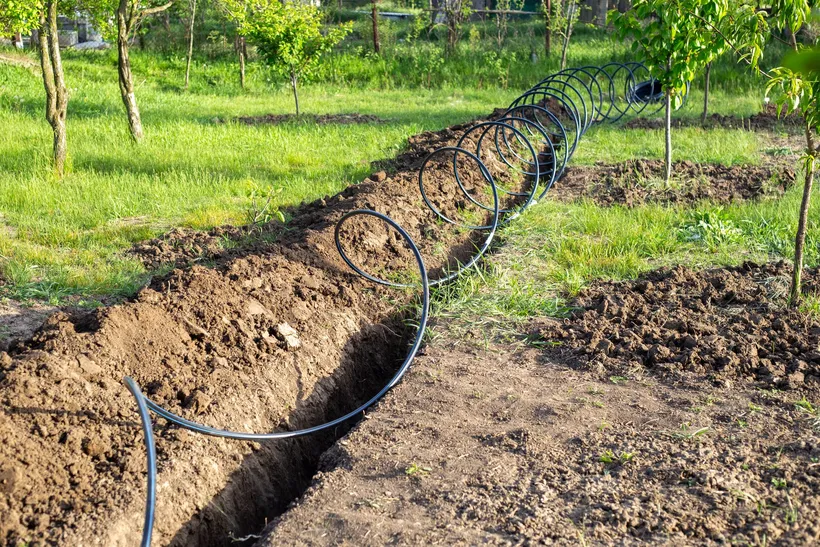
A trench dug through grass to lay an irrigation pipe. It isn’t from here, and it’s the main pipe, not the drip lines, but it gives an idea of what burying something under an existing lawn involves.
What makes it cost more, part by part
- The pipe. More metres the closer the lines are, and in sand they’re closer.
- The depth. The guides don’t agree: New Mexico’s says 7 to 15 centimetres; the technical paper, 15 to 30. What they do agree on is that if the lawn is going to be aerated, the lines have to sit below where the machine reaches.
- Drippers protected against roots. The lawn’s roots go looking for water and grow into the dripper. In the tests the technical paper cites, unprotected drippers clogged: 10% after three years, 60% after four and 95% after six. That’s why there are drippers made to be buried, and those are the ones to use.
- Three parts you can’t see. A filter at the inlet, because a buried dripper that clogs can’t be cleaned by hand. An air valve at the highest point of each zone, which stops the line sucking soil in through the drippers when the water shuts off. And a flushing manifold at the end of the lines, to purge them.
- The controller and the zones, as with any automatic irrigation. And if the lawn is on a slope, drippers that give the same at the top as at the bottom: see pressure-compensating drippers.
The hard part to believe: you can’t see the water
With a sprinkler, if something goes wrong, you see it. With subsurface drip you don’t, and the technical paper says it plainly: you have to learn to irrigate without seeing the water, by watching how the lawn looks. The first warning of a design mistake is stripes.
The water you can’t see, in section
In a clay soil. The water from each dripper spreads sideways, and the wet bulbs from two lines meet. The lawn above gets water all over.
In a sandy one, with the same spacing. The water goes down more than it spreads. Between one line and the next the soil stays dry, and the lawn shows it in yellow stripes.
With the lines closer together. The bulbs meet again. That’s why the soil decides the spacing: the guides go from about 30 centimetres in sand to 45 or 60 in clay.
Underground, each dripper wets a bulb of soil. If the lines are too far apart for that soil, the ground between one and the next stays dry, and the lawn above shows it in yellow stripes. The technical paper puts it this way: the further apart the lines, the harder it is to avoid stripes. That’s why the spacing isn’t picked from a catalogue, but from the soil in each garden.
When it pays off
- In water. The New Mexico guide cites published savings of 50 to 90%, because nothing evaporates while it runs, the wind doesn’t carry it off and there’s no sprinkler overlap.
- In narrow, irregular or sloping areas. Where a sprinkler wets the wall, the path or the pavement.
- In long, narrow strips. The same guide says it costs more than sprinklers when many connections are needed, and less in long, narrow areas with few.
- When the lawn is in use. You can walk on it while it waters.
The catch here: drought
In the city of Málaga, the town hall’s by-law of November 2023 banned watering gardens, public or private, with mains water. When it was relaxed, from 1 June to 30 September 2024, survival watering of trees, shrubs and plants was allowed one day a week. With one exception, in the town hall’s own words: “lawns are not included”. The restrictions weren’t lifted until May 2025.
In other words: in the drought, lawns went without mains water however they were watered, by subsurface drip or by sprinkler. Drip saves water in normal years, and that’s no small thing. What it doesn’t do is give permission to water when there are restrictions. If what you want is a garden that can get through a year without watering, the answer isn’t in the pipe, it’s in what you plant. The alternatives are in a garden without a lawn.
What to ask for in the quote
- The spacing between lines, and why that one for your soil.
- The depth, and whether the lawn will be aerated.
- Drippers made to be buried, with root protection.
- Filter, air valve and flushing: that they’re there, and where.
- What happens to the existing lawn: lifted, trenched, or wait until it’s renewed.
- How you’ll know if something fails. The honest answer is by watching the lawn. How to compare two quotes, in fixed price or hourly rate.
In short
Subsurface drip under a lawn costs more than sprinklers because of the pipe, burying it and parts you can’t see, and its price depends on the soil before the square metres. It saves water, especially in narrow or sloping areas.
But you can’t see the water, and a design with the lines too far apart shows up as stripes. And in a drought like the last one, the lawn goes unwatered all the same. What we do with irrigation is in automatic irrigation installation.