Blog · Olive and fruit trees
When to pick the olives on your garden olive tree (and why by hand)
There’s no single date: it depends on what you want them for. Green, turning or black, how to tell from the tree, why by hand and not with a pole, and what to do if the olive is only ornamental.
 By Sergio Domínguez6 min read
In October the garden olive starts to change: the olives, green and hard all summer, gradually turn paler and some develop purple patches. It’s the sign that there’s a decision to make.
And what you’re deciding isn’t a date. When to pick them depends on what you want them for: olives for curing aren’t picked at the same time as olives left to ripen, and neither are those on a tree that’s only there for show. The short answer, for green curing olives: early in the autumn, once they’ve reached full size and before they change colour. Black olives come later, well into the autumn or in winter.
Green, turning or black
Olives go through three colours, and each one is a different moment for picking.
Green, for curing. They’re picked once they’ve reached full size and before they change colour. These are the ones that get cracked or slit and put to soak in water to lose their bitterness. Here they’re the most common: Aloreña, Málaga’s table olive with its own designation of origin, is picked this way, green and early in the autumn, and in the Valle del Guadalhorce it’s cured cracked.
Turning, halfway through the change. Purple in patches, with the skin still firm. Some people prefer them for curing because they’re a little milder than green ones. It’s also the point when picking for oil usually starts.
Black, ripe. They come later, well into autumn or in winter, depending on the tree and the year. They’re softer and bruise at the slightest knock, and they’re the ones that end up on the ground if nobody picks them.
The tree doesn’t ripen all at once. On the same branch there are green, turning and the odd black olive, and the side facing the sun runs ahead of the inside of the crown. So you don’t wait for them all to look the same: you pick when most of them are at the stage you’re after.
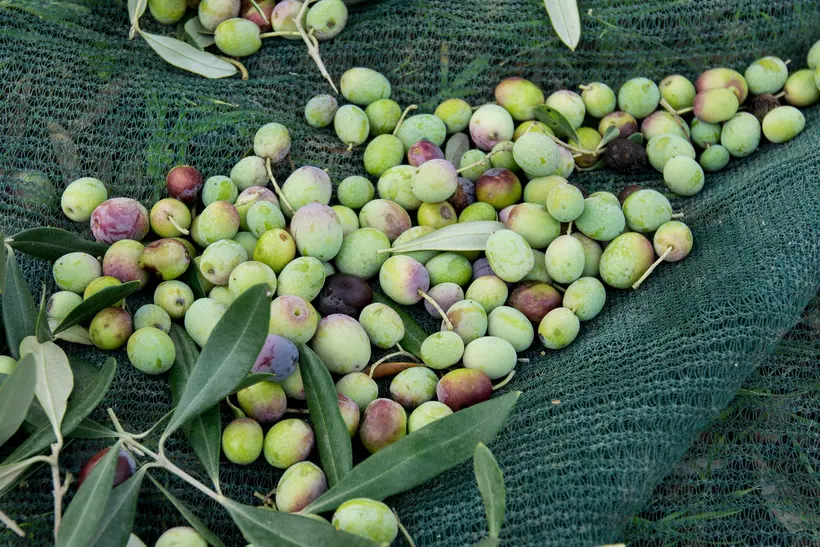
Freshly picked olives on the net. Most are green, a few are turning and the odd one is black, and they were all picked at the same time.
How to tell they’re ready
For green olives, which is what people ask about most, there are three things to look at on the tree:
- Size. They’ve stopped swelling. If you compare a few over a week and they haven’t grown, they’re ready.
- Colour. It goes from a deep, dark green to a lighter green with a hint of yellow. When purple patches start to appear, the time for green curing olives is running out.
- Skin. Smooth, taut and firm when you squeeze. Set aside the wrinkled ones and those with a puncture or soft flesh: they won’t get any better in the water.
And if it’s an Aloreña, Málaga’s table olive variety, there’s a fourth, the age-old one in the Valle del Guadalhorce, set down in the document for its designation of origin: cut an olive round its middle and, if the two halves come away from the stone, it’s time. The Aloreña has a loose stone, which is why the test works with it.
If the tree went thirsty in August and September, the olives stay smaller and some wrinkle early. It isn’t that they’re ripe: they couldn’t fill out, and waiting won’t fix it.
By hand, not with a pole
In the countryside olives are beaten off with poles because there are hundreds of trees. A garden olive doesn’t need it, and it has a cost you don’t see on picking day.
The olive fruits on the wood that grew the year before. The new shoots, the lighter ones at the tips, are the ones that will carry next season’s crop. The pole doesn’t damage this year’s crop, which is already made: it breaks those shoots, and part of next year’s crop goes with them.
The same branch, picked two ways
The same branch, in autumn. This year’s olives hang from the old wood, and the new shoots, lighter in colour, have come out at the tips.
By hand, or beaten with a pole. By hand, the olives come off and the shoots stay. With the pole the olives fall, and many of those tender shoots break with them.
The following year. The olives grow on those shoots. The hand-picked branch loads up again; the beaten one falls short, and it isn’t the weather.
What you do instead is “milk” the branches: spread a net or an old sheet under the crown and run your hand along each branch, from the inside outwards, so the olives come loose and drop. For whatever you can’t reach from the ground, use a stable ladder or one of the hand rakes made for milking olives, which combs the branch without breaking it.
For table olives there’s a more immediate reason too: every knock leaves a dark mark in the flesh, and a bruised olive goes soft in the water. Olives for curing are picked by hand or not at all. And if your olive is loaded one year and gives nothing the next, breaking shoots makes it worse; we cover that in the olive tree that’s loaded one year and gives nothing the next.
If the olive is only ornamental
On this coast many garden olives aren’t there for the olives but for the shade and the look of them. For those the question is a different one: when to get the olives off so they don’t cause trouble.
The answer is early, while they’re green. Green olives stay on the tree; ripe ones drop, get trodden in and leave dark stains on stone and on the terrace that are hard to get out. If the olive hangs over the pool, an entrance or pale paving, picking in October saves you January’s problem.
And if it’s the same story every year, you can tackle the cause: an ornamental olive is pruned for crown and shade, not for a crop, and that way it gives far fewer olives. Which of the two kinds of pruning to choose is covered in gardeners in Alhaurín and Coín, which is where most of the finca olives are.
What not to do
- Beat a garden olive with a pole. You break the wood that has to carry the next crop and bruise this one.
- Pick them and leave them in a bag for days. They heat up, go soft and get marked. Olives picked for curing are started the same day or the next.
- Leave the fallen ones at the foot of the tree. They rot on the ground, stain whatever is underneath and are no use for anything. Sweep them up or gather them with the net.
- Prune now, with the olives still on the tree. It takes this year’s fruit and next year’s shoots in one go. Pruning comes afterwards.
And afterwards, the pruning
Picking closes the olive’s year and opens the next. Pruning comes afterwards: once the fruit is off and before the tree starts to flower, at the end of winter. How that fits with the rest of the garden is in when to prune on the Costa del Sol.
If the olive is big, or there are several, and you want it pruned by someone who knows whether it’s there for shade or for olives, we do that in olive and fruit tree pruning.
In short
Green for curing as soon as they’ve reached full size and before they change colour; turning if you want them milder; black, later, and picked before they drop. If the olive is ornamental, take them off green, in October, before they stain.
Always by hand and over a net, never with a pole: the pole takes the shoots, and next year’s crop with them. And the pruning comes after picking, at the end of winter.