Blog · Olive and fruit trees
Olive leaf spot is decided now, with the first rains
The spot shows in spring, so everyone looks in spring. But olive leaf spot gets in with the first autumn rains, and the garden olive on this coast makes it easy.
 By Sergio Domínguez7 min read
With the first autumn rains, the season for olive leaf spot begins: the fungus that covers olive leaves in round spots and gradually strips the tree bare from below. Hardly anyone notices it now. It gets noticed in spring, when the leaves turn yellow and the ground under the tree fills up with fallen leaves.
And that time lag is the whole problem. What you see in spring was infected in autumn. Anyone who waits to see the spot before doing something is months late.
How to recognise it
The sign is a round, dark spot on the upper side of the leaf, often surrounded by a yellowish ring. That’s why it’s also known as “peacock spot”. Around the spot the leaf turns yellow, and in the end it drops.
Seen from a distance, the tree goes bare from the bottom up and from the inside out: the low branches and the inside of the crown are left with few leaves, while the top and the outside stay green. That’s exactly the part that takes longest to dry after getting wet, and it’s no coincidence.
If the leaf yellows without a spot, or if what it has is a grey powdery coating on the underside, it’s something else. The second is what’s called repilo plomizo, which is a different fungus. And if the tree also has lumps on its branches, that isn’t leaf spot either: it needs looking at.
Why autumn decides it
The fungus spends the summer in the leaves that carry last year’s spots and are still on the tree. Heat stops it; it doesn’t kill it. When the rain returns, the water splashes its spores onto the new leaves, and if a leaf stays wet long enough in mild temperatures, the fungus gets in. Autumn and spring are its two seasons.
What nobody expects is what happens next. For weeks, sometimes months, the infected leaf looks just like a healthy one.
The same branch, from autumn to spring
Autumn. It rains, the leaf stays wet for hours and the rain splashes spores from the leaves carrying last year’s spots. That’s enough for the fungus to get into the new ones.
Winter. The infected leaf looks just like the healthy ones. The fungus is inside and growing, but for weeks, sometimes months, there’s nothing to see.
Spring. The spot appears, the leaf yellows and drops. By the time you see it, that leaf was already lost: it was infected in the autumn rains.
That gives you the only rule that matters: against leaf spot you protect the leaf before it gets wet, not after the spot appears. A leaf with the spot already formed can’t be cured. Everything that works is preventive, and that’s why it’s decided now.
Why the garden olive here makes it easy for the fungus
The olive is a dry-land tree. In the countryside it’s well spaced, in full sun, and nobody wets its crown: after rain, it dries quickly. The garden olive on this coast lives the other way round, and almost everything we do to it lengthens the hours of wet leaf, which is all the fungus needs.
- It’s in the middle of the lawn. The lawn sprinkler wets the lower part of the crown every time it runs, which is exactly where it starts to go bare.
- It’s pruned dense to give shade. A dense crown is cool underneath, and inside it takes much longer to dry.
- It’s right up against a hedge or a wall, with no breeze to dry it.
- And it’s near the sea. Humid nights, early-morning dew and mild winters that don’t check the fungus the way cold would.
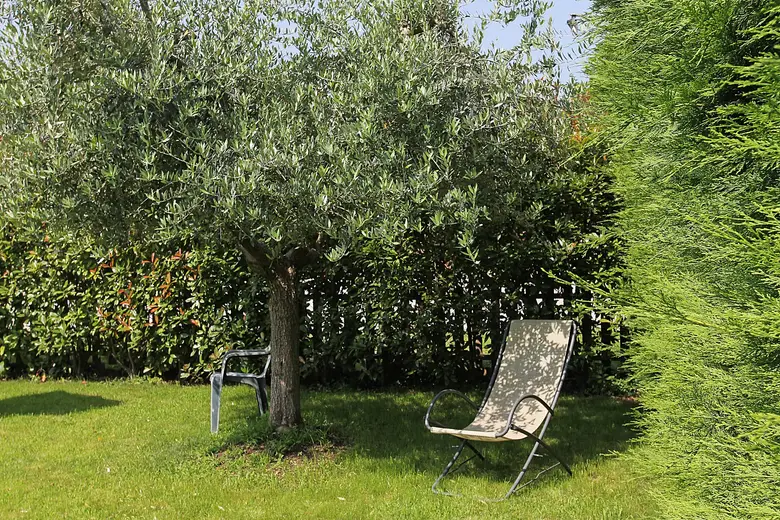
The textbook garden olive: in the middle of the lawn, with its crown kept dense for shade and boxed in between the hedge and the cypress. It’s the nicest spot in the garden to sit and the most comfortable one for leaf spot: after every watering and every shower, that crown takes a long time to dry.
In the valley olive groves, out towards Alhaurín and Coín, leaf spot exists too, but the trees don’t have a sprinkler underneath. The difference isn’t the variety or the care. It’s the position.
What to do now, without products
There are three things that depend on you and that work every year, with or without treatment:
- Keep the irrigation off the crown. If the lawn sprinkler reaches the low branches, change the nozzle or its arc. And water in the early morning, so the sun dries whatever gets wet; not at night. We explain it when talking about how much and when to water in summer: foliage that stays wet all night is an open invitation to fungi.
- Check how much it has. If today there are leaves with spots low down and inside the crown, the tree has a source of infection this autumn. If you can’t see any, the risk is much lower.
- Open up the crown when pruning. Remove the branches that close up the interior and lift a little the ones that almost touch the lawn, which are the ones that stay wet longest. That pruning is done at the end of winter, not now, but it’s worth deciding on it while looking at the tree this autumn.
If your olive bears fruit, there’s one more reason: losing leaves in spring shows in the flowering and in the crop. And it adds to alternate bearing, the olive’s on-year, off-year, which is seesaw enough already.
And the treatment
It exists, it’s preventive and it’s done before the rainy spells, not when the spot appears. Which product, at what dose and who applies it, we’re not going to say here: it has to be authorised for olives, it’s applied as its label says and, beyond what’s sold for home use, it’s applied by someone holding the relevant applicator’s licence.
A tip so you don’t pay for more than you need: if someone offers to treat in spring because that’s when the spots show, ask what they want to protect. The spotted leaves can no longer be saved. What gets protected in spring is the new leaves, and that makes sense. Treating to “cure” what you can already see doesn’t.
The pruning that opens up the crown without taking away what the olive is, ornamental or fruiting, is on the olive and fruit tree pruning page.
In short
Olive leaf spot gets in during autumn, with the rain and the wet leaves, and doesn’t show until spring. When the spot appears, that leaf was already lost. That’s why everything that works comes before.
Here the garden olive makes it easy: lawn, sprinkler, dense crown and a hedge alongside. The cheapest measures are the ones that depend on you: keep the irrigation off the crown, check now whether it has spotted leaves, and open up the crown in the winter prune.