Blog · Olive and fruit trees
The lemon tree’s leaves turn yellow and the veins stay green
The iron is already in your soil. The problem is that in chalky soil the roots can’t take it up, and that’s why the bag of iron sulphate did nothing.
 By Sergio Domínguez8 min read
The lemon tree puts out its late-summer flush and it comes out yellow. Not wilted, not dry: yellow, with the veins picked out in green on top of the yellow, like a leaf drawn in pencil. And the first thing almost everyone does is water more and add fertiliser, which are the two things that won’t fix it.
Look at the pattern of the yellow, not the yellow
A yellow leaf tells you nothing on its own. What does tell you something is where the yellow starts and which parts are spared, and that separates three things that are dealt with differently:
- Yellow between the veins, with the veins green, and on the new leaves at the tip. That’s iron deficiency. It’s what this article is about.
- The whole leaf pale, veins included, starting with the old leaves lower down. That points to nitrogen, and that one is put right by feeding.
- The edge of the leaf dry and scorched, with the centre green. That isn’t a deficiency: it’s built-up salt. We cover it fully in why leaves burn at the edges, and there watering more makes it worse instead of fixing it.
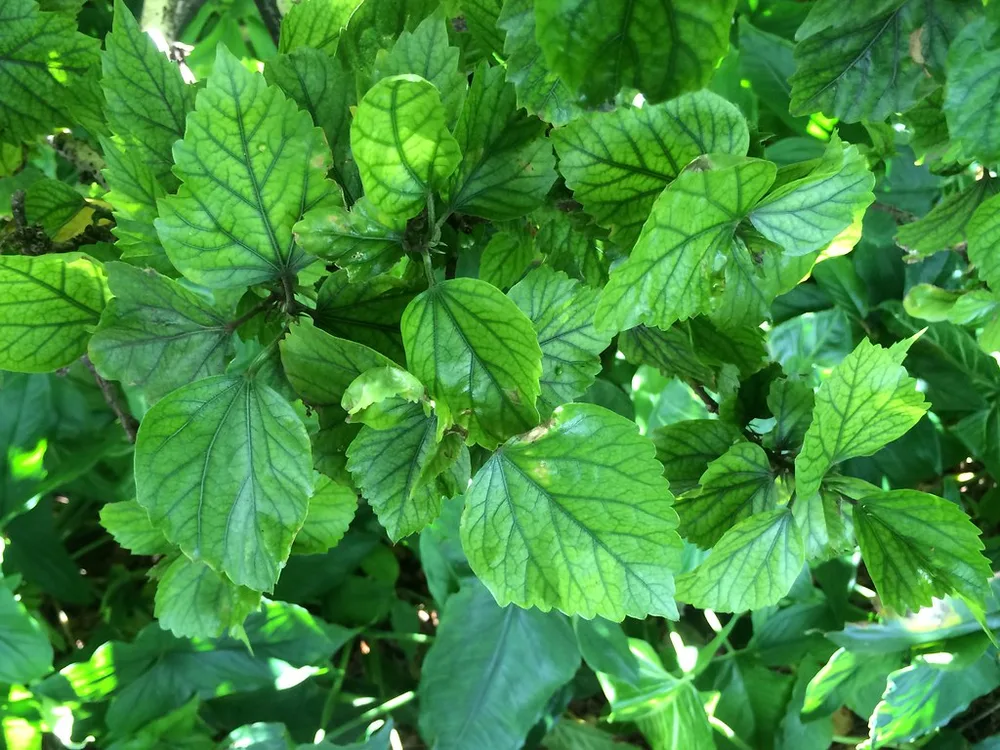
This is the pattern to look for: the leaf blade goes pale and the veins stay green, marked on top. The photo is of a hibiscus (found in every garden here, and it does the same on chalky soil) because it shows up better than on a citrus leaf, but the pattern is identical. In the background, leaves on the same shrub that are still completely green.
The detail that it’s the new leaves and not the old ones isn’t a flourish in the diagnosis: it’s the proof. Iron, once it’s inside a leaf, stays there; the tree can’t take it back out and send it to the new flush. So when it’s short, the old leaves stay green quite happily and the yellow appears only in what’s coming out now. If the yellow is lower down and the top is green, it isn’t this.
Your soil isn’t short of iron
This is the part that’s hard to believe. There is iron. There’s iron in almost any soil in the world, and in yours too. What there isn’t is iron the roots can take up, which is another matter.
Iron only gets into the plant if it’s dissolved in the water in the soil, and what decides whether it dissolves is the pH. In an acid soil it’s available. From pH 7.5 upwards (the pH of any chalky soil) it precipitates: it turns into solid compounds that stay there, touching the root, without the root being able to do anything with them. The tree is sitting on top of a locked larder.
And you can check this at home in a minute. Take a handful of soil from under the tree, put it on a plate and pour a splash of vinegar over it. If it bubbles and fizzes, there’s lime in it, and where there’s lime the pH is high. In gardens on the coast it usually bubbles.
And on an urbanisation the soil is often worse than chalky
A hillside garden in Mijas, Benalmádena or Fuengirola is almost never on natural soil. It’s on fill: what was moved when the plot was terraced, plus the building rubble, plus the remains of mortar and concrete that got buried where the tools were washed. And cement is lime. A bed right against a wall or the edge of the pool is often the worst spot in the garden in this respect, and you can’t see that from above.
On top of that, the water you irrigate with also carries lime. Every watering leaves a little, and after a whole summer of daily watering, what’s under the tree holds more carbonate than it did in May. That’s why the flush that comes out yellow is September’s and not March’s: it’s the time of year when the soil is carrying the most lime.
It’s one of those things that repeats itself street by street. In the hillside areas (Mijas, Benalmádena) the problem is usually the fill; on the flat plots further down, the water.
That’s why the bag of iron sulphate did nothing
It’s what everyone buys, and it’s logical: the leaf is asking for iron, the bag provides iron, the bag is cheap. The problem is that iron sulphate is loose iron, and loose iron in chalky soil lasts as long as it takes to touch the ground. It oxidises, precipitates, and you’re back where you started: iron in the soil that the roots can’t take up. You’ve added a problem to the problem.
What does work is chelated iron. A chelate is a molecule that wraps around the iron atom and doesn’t let go, so the soil pH can no longer knock it out. But not all chelates are equal, and here the small print decides: EDTA breaks down above pH 6.5 and DTPA can’t cope with a fully chalky soil. The one to look for on the label is EDDHA, which stays stable at the pH we have here. It costs more per bag and it’s the only one that will do anything.
The same soil, the same iron, two forms
It isn’t that one bag has more iron than the other. It’s that in chalky soil loose iron turns insoluble as soon as it touches the ground and stays there, a hand’s breadth from the root and out of its reach. A chelate is a molecule that carries it wrapped up and doesn’t let go, so it arrives intact.
How to apply it so you don’t waste it
- To the soil, with the irrigation water, not to the leaves. Foliar iron greens up the leaf it wets and no other, because (once again) the tree doesn’t move it from one leaf to another. It’s a patch for one particular plant; it doesn’t sort out the tree.
- Where the roots are, which is the whole circle under the crown, not a hole next to the trunk.
- Before the flush, not once it has come out yellow. A leaf that came out chlorotic stays that way; what the application decides is what colour the next one comes out.
- And knowing it’s a stopgap you’ll have to repeat. The chelate doesn’t lower the soil pH: it gets round it. As long as the soil stays as it is, the tree will keep asking for it.
What fixes the underlying problem, which is slower
Lowering the pH of a whole chalky soil can’t be done: there’s too much lime to neutralise. What can be done is improve the patch where the roots live, and that’s done with organic matter. Compost and mulch, every year, without digging. As it breaks down it acidifies that zone a little and, above all, releases compounds that keep the iron available on their own. It’s the same step that improves water retention, so it isn’t extra work.
It also helps to remove whatever makes it worse: waterlogging from irrigation worsens chlorosis, because a root without oxygen absorbs less well, and compacted soil does the same. If the yellow appears just after a run of long waterings and the soil is slow to drain, that’s half the problem.
When it isn’t iron
If the tree has been yellow for years, doesn’t respond to anything and is also at a standstill (short shoots, small leaves, branches dying back from the tip), it’s probably not a deficiency but the roots: suffocation from too much water, a root ball that never grew out of its planting hole, or a buried root collar. Then the chelate is money down the drain.
And if what’s yellow is an olive and not a citrus, be careful, because the olive copes with lime far better and rarely gets chlorosis. In an olive, an odd year usually has a different explanation: alternate bearing and what the tree decided the year before.
In short
A new leaf that’s yellow with green veins means a lack of available iron, not a lack of iron. The cause is the coast’s chalky soil, made worse by building fill and hard irrigation water. Iron sulphate doesn’t correct it because it gets locked up just like the iron that was already there; what corrects it is an EDDHA chelate applied to the soil, before the flush, backed up with organic matter year after year. And if the tree is also at a standstill, leave the bag where it is and look at the roots.