Blog · Olive and fruit trees
The olive tree that’s loaded one year and gives nothing the next
It isn’t sick and it isn’t short of water. The year it loads up with olives it spends what it needed to prepare the next one, and enters a seesaw that feeds itself.
 By Sergio Domínguez8 min read
Last year you couldn’t keep up: olives even on the low branches, the ground covered and the tree bowed under the weight. This year you’ve counted what’s there and you have fingers to spare.
The first thought is that something’s wrong (the pruning, the water, a pest). It almost never is. It’s the tree itself, doing exactly what it has been doing for thousands of years, and it has a name: alternate bearing.
What alternate bearing is
The olive alternates. A heavy year and a rest year, and not by chance: the heavy year causes the rest year.
The key is the tree’s internal calendar, which is less intuitive than it looks. The buds that will flower next spring are formed this summer, at the same time as the tree is filling this year’s olives with oil. Two expensive jobs at once, on a single budget.
When the crop is big, it takes almost everything. The tree forms few flower buds, and the following spring it flowers poorly: a rest year. And since that year it spends hardly anything on fruit, it has plenty left over to form buds galore, so the year after it loads up again. The seesaw feeds itself.
The same energy, two destinations
This year’s olivesThe heavy year takes almost everything the tree has.
Buds for next yearThey form now, in summer, with whatever is left over. And little is left.
And it’s being decided now
This is the part not to overlook. When you look at the tree in January and see few olives, there’s no fixing that any more: it was decided the summer before. What you can influence is what’s happening these weeks, in August and September, while the fruit fills out and the buds are forming.
An olive that goes thirsty in the middle of filling doesn’t share out the cut evenly: it sacrifices first whatever won’t give it anything this year, which is precisely next year’s buds. That’s why a hard summer is paid for twice, once now and again nine months later.
How to read the tree
You can tell quite a lot before spring comes, and you only need to look at two things: how many olives there are and how much new growth it has put out.
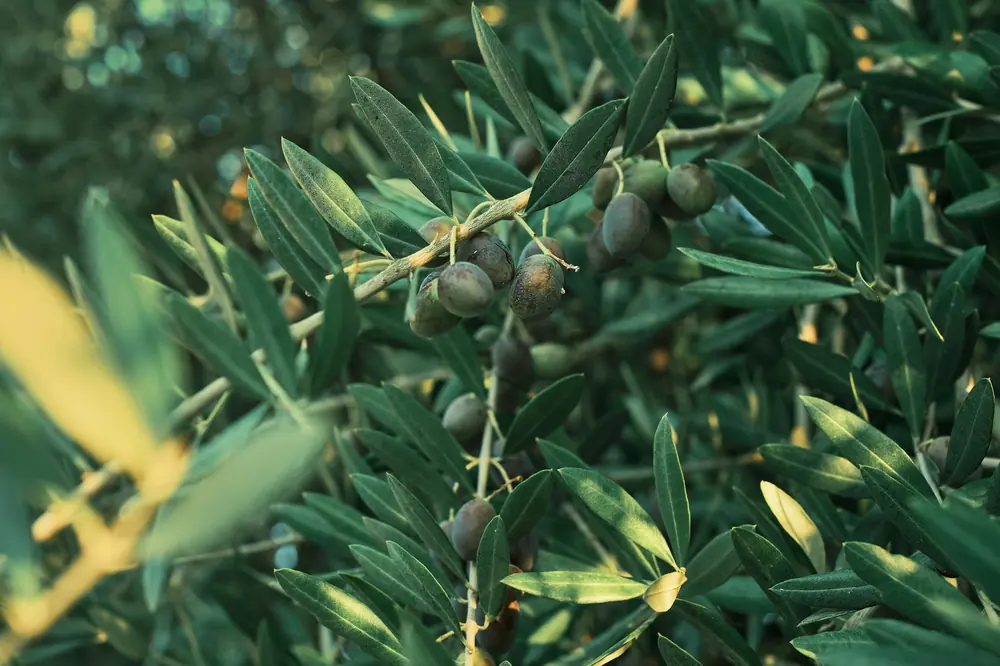
The olive doesn’t fruit on old wood: the olives hang from the branch that grew the year before. The light, soft shoots you see now are the wood that will carry olives next season.
With that, the diagnosis makes itself. Lots of olives and almost no new shoots: next year is going to be poor, because there’s nothing for them to grow on. A moderate crop and shoots everywhere: next year has what it needs. And a tree that neither fruits nor shoots isn’t alternating; something else is holding it back (water, competition from other roots, or years without its crown being opened up).
What can be done
Soften it, yes. Get rid of it, no. An unirrigated olive in a garden will always alternate a little, and that’s normal.
Prune a little every year. It’s what helps most and what’s done least. The usual thing is to leave the olive for three or four years and then give it a hard going-over, which almost always falls in a rest year because that’s when it looks neglected, and so the seesaw gets worse. A light prune every year keeps up a steady trickle of young wood, which is where it fruits.
Thin the fruit in the heavy year. Removing some of the fruit early, while it’s still small, frees the tree to form buds. In a big grove it doesn’t pay; on one or two garden trees it’s perfectly manageable and it shows the following year.
Water and feed during filling, not in winter. The moment when what you give it makes a difference is this one, when the tree is doing both things at once. If you have irrigation, August and September are the months that count. How to do it without wasting half of it is in how much to water the garden in summer.
If your olive is ornamental, read this the other way round
It’s worth saying, because on this coast most garden olives aren’t there for the olives but for the shade and the look of them. In that case the heavy year isn’t good news, it’s a nuisance: the fruit drops, stains the paving and the terrace, and attracts olive fly.
Then the sensible decision is the opposite: thin hard or remove the fruit, and prune for crown and shade instead of for a crop. They’re two different kinds of pruning and you have to choose one; we cover it in detail in gardeners in Alhaurín and Coín, which is where most of the finca olives are.
What isn’t alternate bearing
Before resigning yourself to the seesaw, rule out three things that look like it and aren’t.
It never flowers, any year. If the olive is right by the sea, the most likely reason is that it doesn’t get cold enough in winter. The olive needs a spell of low temperatures to be able to flower, and on the beachfront many winters don’t give it one. The same tree, twenty minutes inland, sets fruit without any trouble. It isn’t alternate bearing, and pruning won’t fix it.
It flowers heavily and sets nothing. That points to the flowering period: rain or strong wind on those days knocks off the pollen, and some varieties set much better with another tree nearby to pollinate them.
It sets and then drops, small and wrinkled. That’s thirst at the wrong moment, not alternation. And it usually comes with dull leaves and short shoots.
In short
If there are no olives this year and last year there were too many, you almost certainly don’t have a problem: you have an olive tree. What you can do is stop making it worse: a light prune every year, thinning when it loads up, and water during filling. What you can’t do is expect the same crop every year from a tree that has never worked that way.
When to do each thing, month by month, is in the Costa del Sol pruning calendar.