Blog · Olive and fruit trees
When to pick avocados from the garden, and why they don’t ripen on the tree
On the tree it doesn’t soften: you pick it hard and it ripens in the kitchen. When Bacon, Fuerte and Hass are due, and the fruit test to tell whether yours is ready.
 By Sergio Domínguez6 min read
Plenty of gardens on the coast have an avocado tree, and in autumn it hangs heavy with hard green fruit. The question is always the same: when do you pick them? And the answer starts with something that surprises people: there’s no point waiting for them to soften on the tree, because on the tree they don’t.
Avocados don’t ripen on the tree
It’s one of the very few fruits that works this way. While it’s hanging, an avocado stays hard, however long it’s there, and keeps building up oil. Only once it’s picked does it start to ripen: a few days at room temperature and it softens and is ready to eat.
That has two consequences. The first is that waiting for one to go soft on the branch is waiting for something that won’t happen. The second is a good one: the tree is the store. Once the fruit is mature, there’s no need to pick them all at once. You pick them as you need them, and a single tree’s season stretches over months.
Where an avocado ripens
It doesn’t ripen on the tree. An avocado can hang for weeks without softening. The tree stores it: while it’s on the branch it stays hard, and keeps building up oil.
It ripens after picking. Once it has the oil it needs, you pick it, leave it at room temperature, and in a few days it softens and is ready.
Picked too early, it won’t. Pick it before it’s ready and it never gets there: it shrivels, goes rubbery or doesn’t soften, and has no flavour. That’s why the fruit sets the date, not the calendar.
What decides whether it’s mature can’t be seen from outside: it’s the oil it has built up. That’s why growers don’t go by size or colour but by the dry matter of the flesh, measured in a lab. At home, the way to tell is the fruit test, further down.
Which avocado you have, and when it’s due
In Spain, the season starts in autumn with the smooth-skinned varieties and carries on with Hass, which needs longer on the tree:
- Bacon, Fuerte, Zutano. Thin, smooth, green skin that stays green when the fruit is ripe. They come first: picking starts in autumn.
- Hass. Thick, pebbly skin that turns almost black as it ripens, once off the tree. The industry asks for it not to be picked before mid-November, and it’s picked through winter and spring.
- An avocado grown from a stone. Nobody knows what variety it is or when it’s due: for that one, the fruit test is the only guide.
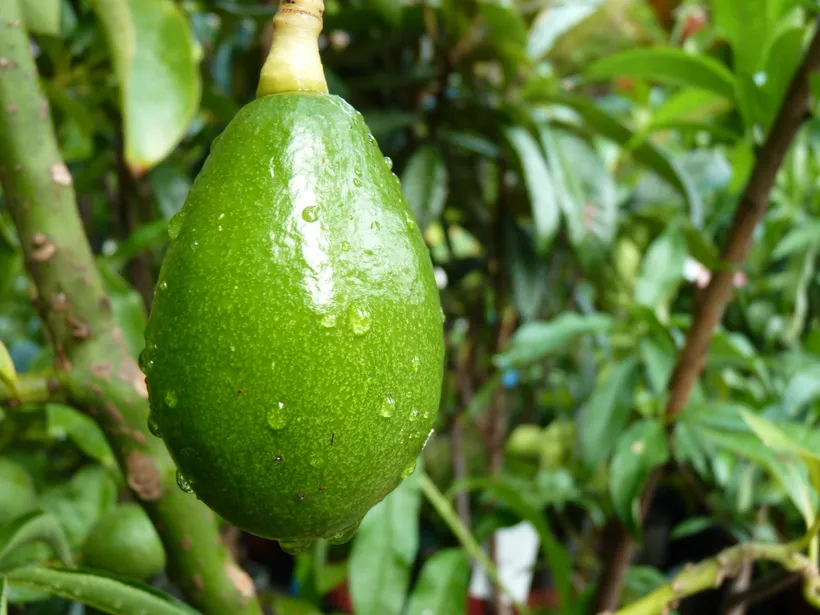
A thin, smooth-skinned avocado, still on the tree. The smooth-skinned ones, like Bacon or Fuerte, are the first to be picked; Hass has thick, pebbly skin.
The dates are a guide. A garden tree isn’t a farm: the spot, the aspect and the year bring it forward or hold it back. What doesn’t fail is the test.
The fruit test
It’s the one the University of California Cooperative Extension recommends to anyone with an avocado at home:
- Pick one of the biggest fruits on the tree.
- Leave it in the kitchen, at room temperature and out of direct sun.
- Wait. If within a week or two it softens evenly, isn’t leathery or bitter, doesn’t shrivel and tastes good, the tree is ready.
- If it shrivels, goes rubbery or has no flavour, not yet. Give it a couple of weeks and try again.
Once the test comes out well, there’s no need to repeat it: from then on, you pick them as you use them.
The ones that fall on their own
Fruit falling isn’t always a bad sign. In spring and summer the tree drops lots of small fruitlets by itself: it’s how it adjusts its load, and those will never ripen.
The ones that fall fully grown, in autumn or winter, are another matter. If the tree was already mature and the fruit isn’t split or bruised, you can leave it in the kitchen like a picked one: it is, in fact, a fruit test the tree has done for you. If it shrivels or won’t soften, it was still too early.
How to pick them
With secateurs, cutting the stalk and leaving a short piece attached to the fruit. Pulled off by hand, the skin tears where the stalk was and rot gets in there. For the high ones, a picking pole with a basket: an avocado that falls to the ground from the top gets bruised, and it shows when it ripens.
And don’t leave them hanging forever
The tree being a store doesn’t mean it’s one without limits. An avocado left too long on the branch ends up losing quality: the flesh deteriorates and it keeps less well once picked.
And there’s a less visible cost. Trials with Hass in Australia found that delaying the whole harvest takes fruit off the following year and strengthens the on-year, off-year pattern; spreading it out, picking part of it earlier, costs much less. Avocados bear in alternate years, just like olives. What that means is in olive tree alternate bearing. So once the test says they’re mature, it’s better to keep picking regularly than to leave the tree loaded until spring.
If there’s an olive in the garden too, its calendar runs differently: see when to pick olives.
And if you’re thinking of planting one, watch out for the cold inland: why an avocado is better planted in spring than in autumn is in when to plant on the Costa del Sol.
If you’d rather we had a look, along with the pruning and the rest of the fruit trees, see olive and fruit tree pruning.
In short
Avocados don’t ripen on the tree: you pick them hard and they soften in the kitchen in a few days. In autumn the smooth-skinned ones, like Bacon or Fuerte, come first, and Hass not before mid-November.
To find out whether yours is ready, pick a big one and let it ripen: if within a week or two it softens well and tastes good, go ahead. Then keep picking as you use them, without leaving the tree loaded until spring, which it pays for the following year.