Blog · Olive and fruit trees
When to prune a lemon tree, and what comes off in any month
Pruned lightly, from February to April, and not in summer. What does come off in any month is suckers: the ones below the graft are another plant.
 By Sergio Domínguez6 min read
A lemon tree is pruned from February to April, and not much: dead wood, crossing branches and suckers. Now, in autumn, isn’t the time to prune it. The only things that come off in any month are suckers and the odd dead twig, and suckers are best removed whenever they appear.
It seems very little for a tree that grows so much, and it’s what surprises people who are used to pruning other fruit trees most. But a lemon isn’t pruned like a peach or an olive.
A lemon tree needs little pruning
Deciduous fruit trees are pruned every winter so they don’t break under the crop and so light gets inside. Citrus doesn’t need that. The wood is strong, the fruit comes all over the canopy except in the shadiest parts, and the lemons from a lightly pruned tree are as good as, or better than, those from a heavily pruned one. That’s what the University of Arizona’s citrus pruning guide says, written for a very sunny climate, like this one.
That doesn’t mean leaving it alone. Dead wood comes off, as does anything crossing or rubbing the fruit, anything in the way of the trunk or the irrigation, and the suckers. If the centre is so dense that there isn’t a single lemon inside, it’s thinned a little. And that’s it.
When: February to April, and why not in summer
The right window is late winter and spring. What sets it isn’t so much the cold as the sun:
- From May to mid-October, no heavy pruning. When branches come off, a trunk and thick branches that were in the shade are suddenly exposed, and the bark burns. Pruned in spring, the tree has time to put out new leaves that cover it before summer.
- From November to January, nothing heavy either, because pruning sets off new growth, and tender growth is the first thing lost if there’s a frost. Right by the sea there’s hardly ever a frost, but in the Guadalhorce valley and further inland, the odd January night does freeze.
- Flowers are lost either way. Even before you can see them, they’re already inside the buds, and every cut takes some. With light pruning, the loss is small. With heavy pruning, it isn’t.
How it fits with the rest of the garden is in when to prune on the Costa del Sol.
A “four seasons” lemon is never “clean”
Garden centres here very often sell a lemon called “four seasons”, which is usually the Eureka variety. It’s one of the varieties that flowers most often in the year, so it almost always has flowers, small lemons and ripe lemons all at once.
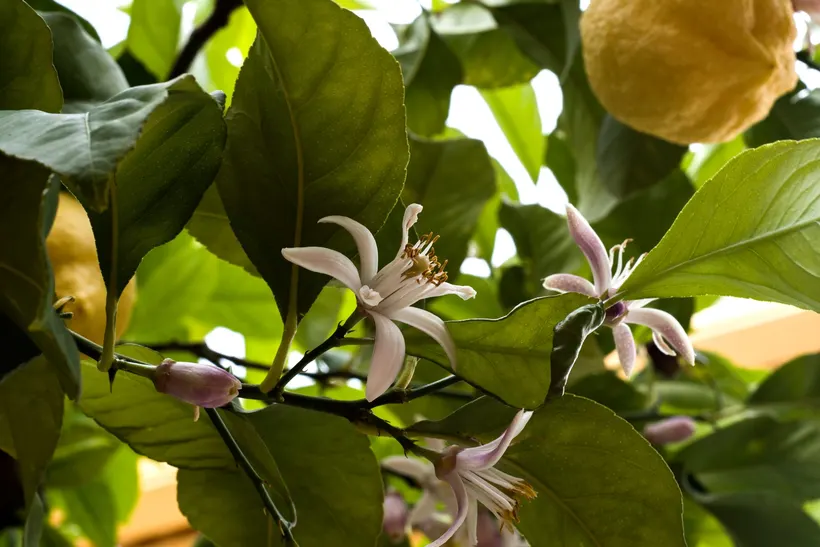
Flowers, buds and a ripe lemon on the same branch. On a four seasons lemon that’s normal, which is why there’s never a moment when pruning costs nothing.
With this tree there’s no moment when pruning doesn’t take something. The answer is the same: February to April, after picking whatever is ripe, with few, small cuts. You lose the odd flower, and the tree replaces it at the next flowering.
What comes off in any month: suckers
There’s one exception to the calendar, and it’s what makes the most work on a lemon tree: suckers. They come off when they appear, whatever the month, and best while small, by hand, which does the least damage.
What comes off a lemon tree, and when
A grafted lemon tree. Above the graft, which shows as a change in the bark or in the thickness of the trunk, is the variety that gives the lemons. Below it is the rootstock: another plant, the one that provides the roots.
What always comes off. A shoot from below the graft belongs to the rootstock: it grows thorns, gives inedible fruit and, if left, ends up crowding out the lemon. And the upright water sprout, thorny and vigorous, which only fruits at the tip. Best removed small, by hand.
The real pruning: little, and from February to April. Dead wood, crossing branches and anything rubbing the fruit. The low skirt stays: that’s often where the best fruit is, and once it’s gone it’s very hard to get back.
- Shoots from below the graft aren’t the lemon: they belong to the rootstock, the other plant the lemon was grafted onto. The graft shows on the trunk as a change in the bark or in the thickness. If the shoot’s leaves have three leaflets, it’s certainly rootstock; if not, what matters is where it starts. Left to grow, it puts out thorns, gives inedible fruit and ends up crowding out the good canopy. Cut it flush where it starts, without leaving a stub.
- Upright water sprouts that shoot up from the thick branches and rise above the canopy. On a lemon they’re very vigorous and thorny, only fruit at the tip, and snap under the weight and the wind. Off they come, unless one is needed to fill a gap in the canopy.
What not to do
- Take off the skirt. The low branches that reach almost to the ground are often cut so the tree “looks tidy”. That’s exactly where the best fruit often is, shielded from the sun and the wind, and once it’s gone it’s very hard to get back. Only lift what gets in the way of watering or of reaching the trunk.
- Clip it into a ball every year, like a hedge. Heavy pruning sets off lots of suckers, which is what then has to come off.
- Leave the trunk in the sun. If pruning exposes the trunk or a thick branch, paint it white with diluted water-based paint or with lime, so it doesn’t burn.
- Seal the wounds. A clean cut, without a stub and leaving the swelling at the base of the branch, closes on its own. No paste needed.
And if what worries you about your lemon isn’t pruning but the leaves, yellow with green veins has its own explanation in yellow leaves on a lemon tree. For lemons that split on the tree, see why oranges and lemons split.
In short
A lemon tree is pruned little and from February to April: dead wood, crossing branches, anything rubbing the fruit, and thinning the centre only if there are no lemons inside. Not in summer, because the sun burns the bark that’s left exposed; and in winter, little, where it freezes.
Suckers, on the other hand, in any month: the ones below the graft because they’re another plant, and the upright ones because they only fruit at the tip. And the skirt stays, because that’s often where the best lemons are.