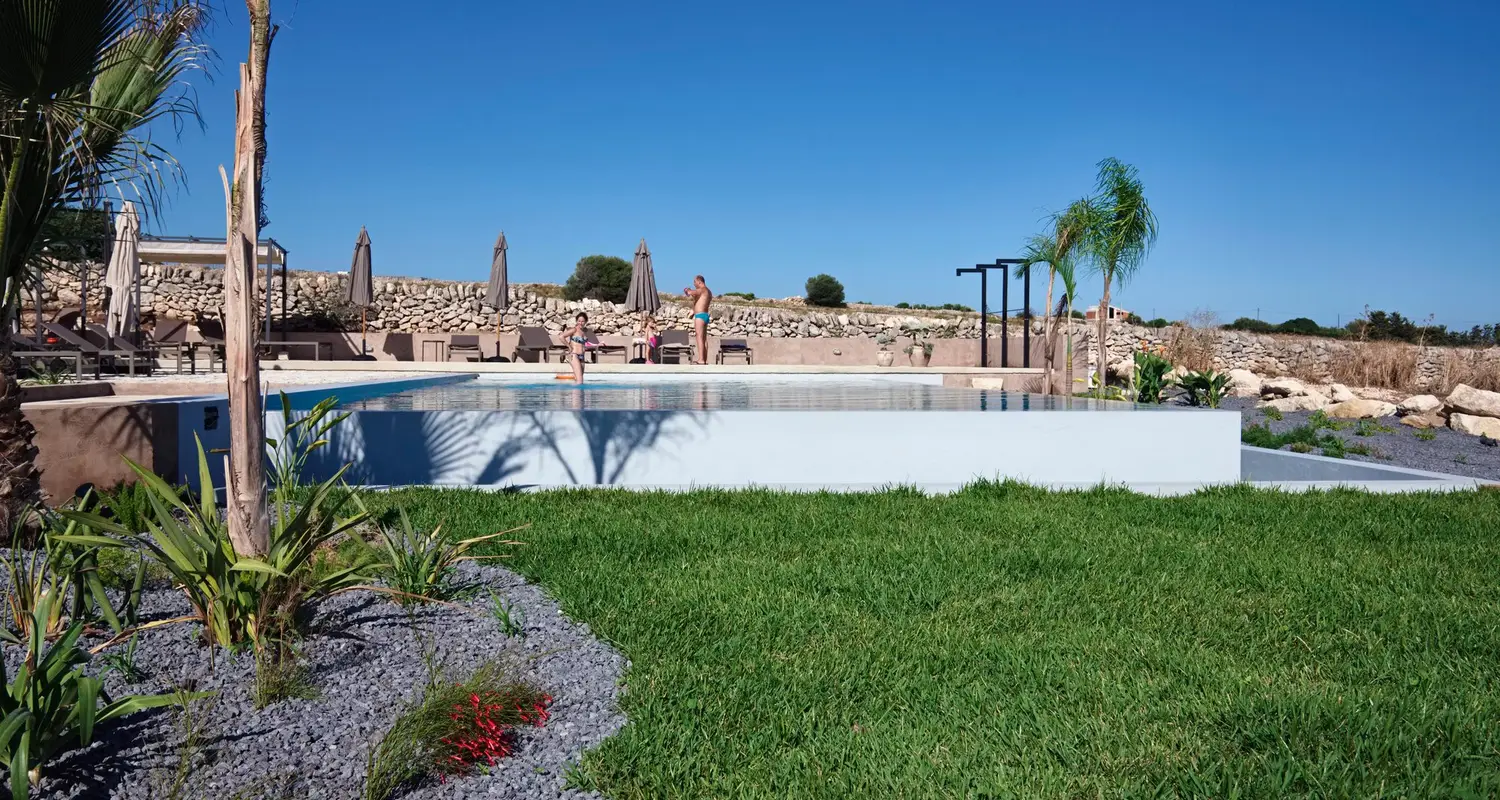
Garden and pool maintenance
The garden and the pool make each other dirty
That’s why it makes sense for the same team to look after both, and it isn’t about convenience. One calendar for both, and one person to call.
- Pruning with an eye on what falls into the water
- Visits placed ahead of the date that can’t move
- A report with photos if you’re not at the house
Tell us about the house
Size of the garden, type of pool and whether it’s let. With that we can put the calendar together.
What’s included
Two kinds of maintenance with opposite rhythms
The garden needs more in spring and autumn; the pool, in summer. Coordinating the two is half the service, and it’s exactly what can’t be done when two different companies are involved.
The garden, in cycles
Mowing, edges, seasonal pruning, irrigation checks and feeding when it’s due. The usual, with one difference: here we also prune with an eye on what’s falling into the water.
The pool, in and out of season
Cleaning the pool and the waterline, the baskets and the pre-filter, checking the equipment and the water. In winter the work is different and less frequent, but leaving the pool completely idle costs you in April.
Where the two meet
The skimmers, the overflow channel and the edge. That’s where you see what the garden is dropping into the water, and where you can tell whether someone is watching both things or only one.
The dates that don’t move
The day someone arrives at the house, the pool has to be ready and so does the garden. We work towards that date, not to whichever slot happened to come round.
What nobody tells you
Look in the skimmer and you’ll know what you’ve planted
In a villa on this coast, what falls into the pool isn’t autumn leaves: it’s pine needles all year round, jacaranda and bougainvillea flowers, and whatever the palm sheds. Small things, falling all the time, that don’t float for long, so they don’t sit on the surface waiting for the leaf net: they sink to the bottom or get into the circuit.
You see the result in the skimmer basket and the pump’s pre-filter. When those clog up, the equipment works less well, filters less, and the water turns green sooner. And then it looks like a pool problem, when what needs attention is the garden: pruning whatever hangs over the pool, or accepting that the tree, where it stands, is going to cost money every week.
And it works both ways. A pool with a salt chlorinator splashes salty water onto the edge every time someone swims, and the lawn and plants in that first metre are the first to notice. The filter backwash has to go somewhere too, and that somewhere can’t be the flowerbed.
None of this is serious on its own. What turns it into a problem is that, with two companies, each one has a reasonable excuse for saying it isn’t their job.
About the price
Here you don’t just add two quotes together
The figure doesn’t come from adding up what each would charge on their own. It comes from the calendar: how many visits are needed each month and at what time of year, which is what you’re really paying for.
- How much falls into the water. It’s the factor most people underestimate. A pool in the open and one under two pines don’t take the same work, even if the pools themselves are identical.
- What type of pool it is. Chlorine or salt, overflow or skimmer, with or without a cover. It changes the weekly work and it changes what needs watching.
- Whether the house is let. Not because of the work itself, but because the visits can no longer be moved: they’re tied to the arrivals, even in August.
- What happens in winter. Leaving the pool completely idle and bringing it back in April usually costs more than minimal winter maintenance. We tell you beforehand, not in April.
We see the house, propose a calendar with what gets done on each visit, and the price follows that calendar. How each service is measured is explained in gardening prices.
If you don’t have a pool
Then this page isn’t for you
This makes sense when there’s a pool. If what you’ve got is a garden and nothing more, what you’re after is garden maintenance, without paying for coordination you don’t need.
Where we work
Where there are villas, there are pools
This is the service most concentrated in particular areas. Each page describes the typical garden in that town.
Worth reading
We’d rather explain it than keep it secret
Why here you plant in autumn, not in spring
Spring is a good time to plant where the enemy is the cold. Here the enemy is July, and that turns the whole calendar upside down.
Read itWhat to plant here so you’re not watering all summer
August is ending, you look at the garden and the question asks itself. The answer has less to do with the list of plants than with where you put them and what you do in the first year.
Read itWinter-flowering plants: here it’s the other flowering season
Here winter isn’t the garden’s dead season: a group of plants flowers just as the rest stops. Which they are, where they don’t work, and the light that keeps a poinsettia green.
Read itBougainvillea not flowering: it’s too well looked after
It’s huge, green and lovely, and won’t produce a single flower. It’s almost never lacking anything: it lacks nothing, and for this plant that takes away the urge to flower.
Read itBrown in September doesn’t always mean dead
Half a dozen brown plants and the temptation to pull them all out before replanting. Here that’s done in October, not now: several of them aren’t dead, they’re dormant.
Read itWhen to plant tulips on the Costa del Sol, and why they go in the fridge first
Planted in October, as inland, they give leaves and a low flower or none. Here you buy them now, give them weeks in the fridge and plant them in December.
Read itStrelitzia nicolai in the garden: what the houseplant guides don’t tell you
Guides treat it as a living-room plant. In a coastal garden, with 0.2 days of frost a year, it becomes a clump of trunks 6 to 8 metres tall.
Read it
Common questions
What people ask us most
Why combine them? I already have someone for each
If it works, don’t change it. What we usually see when it doesn’t work is always the same: the water is dirty, the pool company says it’s because too many leaves fall in, and the gardener says they already prune what they’re meant to. Taken separately, both are right. Combining them isn’t about convenience: it’s about someone being able to decide to prune earlier, or move a plant, because the problem is in the water.
How often do you need to come?
It isn’t the same for both, which is why we don’t give a number here. In season the pool needs a good deal more attention than the garden; in winter it’s the other way round. What we do is propose a calendar after seeing the house, with what gets done on each visit, and adjust it in the first month if need be.
What if it’s a community pool?
Then it’s a different matter. A pool for communal use has its own requirements for water control and record-keeping that don’t apply to a villa pool, and they vary according to the regulations that cover it. Before quoting we need to see what kind of pool we’re talking about, and tell you so clearly, rather than treating it like a big private pool.
The house is let and there are arrivals almost every week
It’s the most common case here, and what changes is the planning, not the work. We need the arrivals calendar in advance so the visits go before changeovers, not after. And it’s worth deciding beforehand what happens if something big turns up on a changeover day: who gets told and who decides, because on that day there’s no time to ask.
Does your pool keep turning green?
Send us a photo of the pool and another of what’s above it. Very often the fix is in the garden, and that shows up before we even talk about contracts. You can call or WhatsApp us in English.